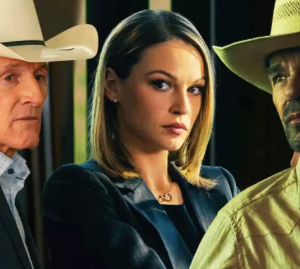
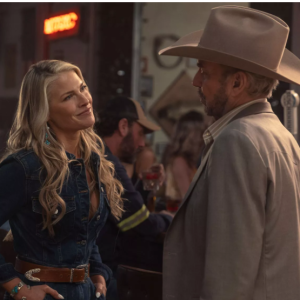
The world of *Yellowstone* is a brutal ballet of power, loyalty, and survival, where every character is forged in the fires of personal struggle. Yet, even within this unforgiving landscape, moments of profound vulnerability can shatter long-held facades, revealing the raw, beating heart beneath the hardened exterior. Such was the case in a recent, intensely dramatic exchange that saw the formidable Beth Dutton, played with searing intensity by Kelly Reilly, drop her impenetrable guard to connect with Monica Long Dutton (Kelsey Asbille) on a level previously unimaginable. Titled “Beth Tells Monica Her Secret,” this scene was not just a pivotal moment for these two women, but a seismic shift in the emotional bedrock of the series, redefining our understanding of one of TV’s most complex anti-heroines.
The scene opens with a quintessential Beth Dutton confrontation: sharp, cutting, and unapologetically aggressive. Surrounded by the ranch hands and Summer Higgins (Piper Perabo), a character Beth delights in tormenting, Beth’s acerbic wit is on full display. “Look at all you sluts,” she sneers, a barbed comment aimed squarely at those perceived as challenging the established order, or merely existing in a manner she deems impure. Her tirade swiftly descends into a philosophical battle with Summer over the institution of marriage, with Beth dismantling Summer’s “hippie bullshit” about oppression. While Summer rails against traditional customs as inherently controlling, Beth, ever the contrarian, champions the sacred union when it’s built on genuine love, venomously reminding Summer that true bondage only exists if one marries “a piece of shit.” It’s a typical Beth performance – a dizzying blend of intelligence, malice, and a strange, distorted moral compass.
This initial volley serves as a crucial setup, firmly re-establishing Beth’s public persona: the unyielding, often cruel, protector of the Yellowstone, whose words are weapons and whose presence demands submission. She revels in pointing out the “very thing that everyone’s thinking but they don’t have the spine to own it and say.” It’s a defense mechanism, a constant offensive posture designed to keep others at arm’s length, ensuring no one gets close enough to inflict pain. But even in this seemingly unassailable fortress of sarcasm and aggression, a tiny crack begins to form.
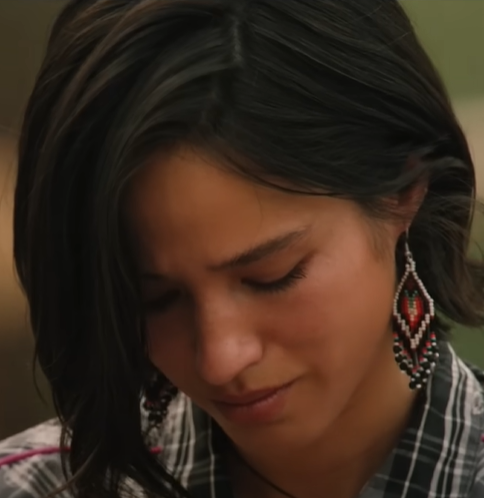
The shift is subtle, almost imperceptible, as Beth prepares to shower. Monica, often a voice of quiet reason and deep empathy amidst the Dutton chaos, offers to show her the bunkhouse. It’s a small gesture, but it signals a nascent connection between two women who, despite their vastly different approaches to life, share a powerful bond through their connection to the Dutton family. It is here, away from the prying ears and the immediate battlefield of the ranch, that the true drama unfolds.
“Why are you so mean?” Monica asks, her voice laced not with anger, but with a genuine, almost childlike curiosity. It’s a question the audience has pondered for seasons, a fundamental query about the source of Beth’s relentless hostility. Beth’s initial response is glib, dismissive: “No reason. Fun.” She rationalizes her cruelty as a necessary truth-telling, an antidote to cowardice. But Monica, who has recently endured the unspeakable grief of losing her newborn son, John IV, is not easily deterred. She sees through the facade, observing that Beth’s behavior, while perhaps amusing to herself, is often “cruel” to others.
Beth, usually quick to unleash another verbal “zinger,” pauses. “Well, that’s why I don’t do it to you,” she responds, the words carrying an unusual softness. She explains that the “cowgirls” and Summer “give as good as they get,” implying a justification for her ruthlessness in those interactions. But Monica’s quiet, devastating rejoinder cuts through the bravado like a knife: “Well, I don’t need to be treated differently just because I lost a child.”
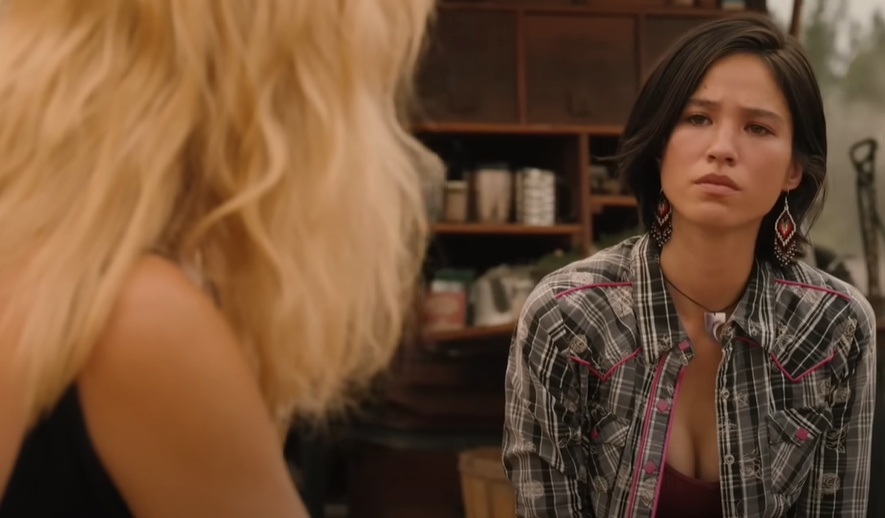
This simple statement is the fulcrum upon which the entire scene pivots. Monica’s vulnerability, her direct acknowledgment of her profound grief, pierces Beth’s defenses. In this moment, Beth sees not just Monica, but a reflection of a pain she has long buried. Her immediate response, “Yeah. You do,” is not a dismissal, but an affirmation, laden with a weight of understanding that transcends words. And then, the dam breaks.
“I’m going to tell you something I haven’t told anybody,” Beth begins, her voice dropping to a near whisper, laden with a raw, uncharacteristic fragility. “So just keep this between us. Okay. I know how you feel because I felt it. And I feel it every day. So when I say that I am sorry, Monica, I really mean it.”
This confession is nothing short of revolutionary for Beth Dutton. For years, her character has been defined by her resilience, her unwavering loyalty to John, and her almost pathological inability to show weakness. Her barbed tongue and confrontational demeanor have been her armor, protecting a wound so deep that even the idea of its exposure sends shivers down her spine. The “secret” Beth reveals, though not explicitly detailed in this dialogue, is a profound, lifelong trauma related to a pregnancy loss. This unspoken tragedy has haunted Beth, shaping her worldview, her cynicism, and her unique brand of self-destructive behavior. It is the core reason for her inability to have children with Rip, a longing that adds another layer of sorrow to her already complex existence.
Monica’s immediate understanding is profound: “That’s why you’re mean because nobody knows. Because you keep that inside yourself.” Her insight is both empathetic and devastatingly accurate. The armor Beth wears is a direct consequence of the immense pain she carries, a protective shell built to prevent further hurt. For Beth, exposing this vulnerability, allowing others to see her pain, is tantamount to inviting further devastation.
Beth’s final words, however, add another layer of cynical self-awareness to her character. While acknowledging that revealing her pain would “hurt,” she dismisses it as the sole reason for her abrasive nature. “Anyway, that’s not why I’m mean. I was a real fucking bitch before it happened.” This last quip, delivered with a hint of her usual dark humor, is a classic Beth move – a quick retreat back into her comfort zone of self-deprecation and brutal honesty, lest she linger too long in the realm of genuine vulnerability. Monica’s dry response, “Well, you’re very good at it,” and Beth’s “I try,” offer a moment of shared, darkly comedic understanding, cementing their fragile new bond.
The impact of this scene is colossal. For Monica, it offers not just solace, but a unique validation of her grief. To hear Beth Dutton, the most outwardly unfeeling character on the ranch, admit to a similar, enduring pain is a powerful step towards healing. It creates an unexpected bridge between two women who, until this point, have primarily existed in each other’s periphery, often defined by their shared connection to Kayce.
For Beth, this is a rare, perhaps unprecedented, moment of genuine connection. It doesn’t instantly transform her, nor does it erase the decades of pain and resentment she carries. But it signifies a crack in the fortress, a glimpse of the wounded soul beneath the warrior’s facade. It reminds the audience that Beth Dutton is not merely a force of nature, but a woman profoundly shaped by trauma, whose aggression is as much a cry for help as it is a declaration of war. Her “meanness” is a shield, a coping mechanism, and an enduring consequence of a pain that, until now, she has carried in agonizing solitude.
This revelation deepens the emotional stakes of *Yellowstone*, weaving a more intricate tapestry of human experience. It forces viewers to re-evaluate every past interaction Beth has had, understanding that beneath the biting sarcasm and the ruthless ambition lies a heart that has been shattered and painstakingly reassembled, piece by painful piece. As the series continues, this shared secret between Beth and Monica will undoubtedly become a significant thread, promising a future of evolving character dynamics and an even richer exploration of the Dutton family’s complex legacy of love, loss, and the enduring scars they carry. Beth Dutton remains an enigma, but for a fleeting, powerful moment, we were allowed to see the pain that fuels her fire, making her not just a character to fear, but one to profoundly understand.