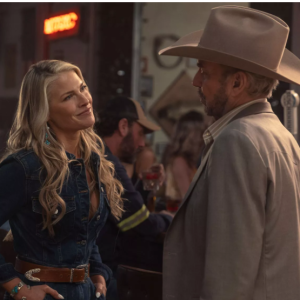
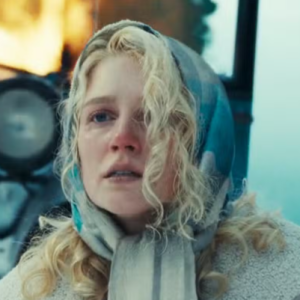
From the sweeping plains of Africa to the treacherous waves of the Atlantic, the love story of Spencer Dutton and Alexandra, Countess of Sussex, has captivated audiences, igniting screens with a passion so fierce it threatened to consume everything in its path. In “1923,” Taylor Sheridan masterfully crafted a romance for the ages, pushing two vastly different souls together through a crucible of danger and defiance, ultimately forging a bond that redefined destiny. Their journey, a relentless test of their commitment against the backdrop of a brutal era, culminated in an agonizing separation that left viewers reeling, promising a reunion that feels as inevitable as it does impossible.
Their introduction was a clash of worlds and wills, a symphony of quiet defiance playing out amidst the vibrant hum of a Kenyan safari party. Alexandra, a British socialite burdened by an impending, loveless marriage, found herself drawn to the enigmatic figure of Spencer Dutton. He was a man carved from the wild, haunted by the horrors of the Great War and the grim reality of his new profession: hunting man-eating beasts across the African continent. Their initial banter, laced with Alex’s playful provocations and Spencer’s stoic retorts, crackled with an undeniable chemistry. Alex, with her keen perception and thirst for genuine experience, quickly pierced through Spencer’s hardened exterior, recognizing the legendary “man-eater hunter” of the Kalahari, Sabi, and Tsavo. She was fascinated by his grim philosophy – “Dying is the most alive you’ll ever feel” – a sentiment born of profound trauma, yet one she found paradoxically romantic. Spencer, accustomed to the silence of the hunt, found himself disarmed by her audacious charm and the undeniable spark in her eyes. Their magnetic pull was immediate, a silent acknowledgment between two souls weary of the conventional paths laid out for them. The fleeting encounter ended abruptly, as Alex was whisked away by her family, but the seed of an unconventional connection had been irrevocably planted.
Their paths, seemingly divergent, converged again at a hotel bar, an almost preordained meeting that underscored the powerful forces drawing them together. Alex, unable to deny the pull, confronted Spencer, teasing him about his nomadic existence, likening him to the very wildlife he pursued. Spencer’s announcement that he would be leaving, heading “East” towards an unknown future, cast a shadow of finality over their nascent connection. It was a moment of stark vulnerability for Alex, admitting her “adventures are over,” a poignant lament for a life unlived. But her spirit, ever rebellious, quickly resurfaced. “Perhaps you’d whisk me away on yours,” she dared, a challenge Spencer initially rebuffed, warning her of the inherent dangers. Little did he know, Alex was hungry for precisely that kind of danger, a thrilling escape from the gilded cage of her preordained future.
The very next day, their lives irrevocably entwined. In a breathtaking act of rebellion, Alex spotted Spencer’s car and, without a moment’s hesitation, ran after it, leaping into his vehicle as it sped away, leaving behind her stunned fiancé, Arthur, and a life of suffocating expectations. It was a leap of faith, a dramatic, cinematic escape that cemented their bond. Spencer, ever the pragmatist, expressed concerns about the perils ahead, but Alex’s resolve was unyielding: “Let’s look death in the eye then, shall we?” This audacious spirit, this fearless embrace of the unknown, was precisely what Spencer, deeply scarred by war and solitary hunts, unknowingly craved. Their shared journey began not with a timid step, but with a defiant sprint into the wild.
Their early days on the road were a whirlwind of blossoming affection and raw honesty. The lighthearted discussion about Spencer’s desire to call her “Alex” – for the sake of efficiency when shouting warnings about lions – underscored their burgeoning intimacy and Spencer’s practical, if slightly awkward, affection. It was Alex who, with a twinkle in her eye, playfully prompted a proposal, noting that if a nickname was this hard, a marriage proposal seemed unlikely. Spencer, true to his blunt nature, wasted no time: “Marry me.” A demand, he clarified, not a question, and one Alex, after a brief, delighted pause, accepted. Their union, born out of impulse and a shared desire for a life less ordinary, was sealed not by societal expectations, but by an undeniable passion.
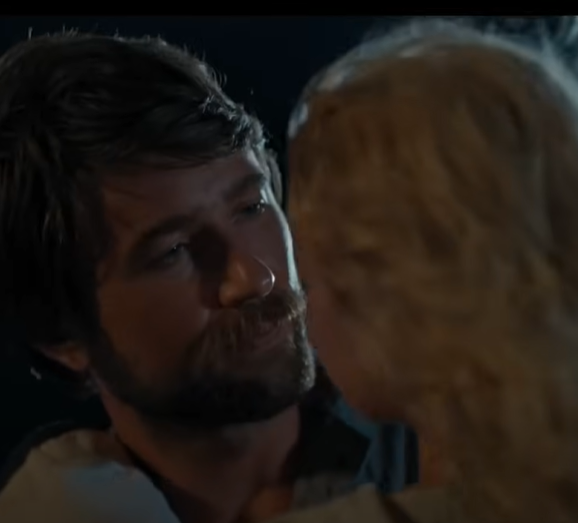
Their love was tested almost immediately, in the terrifying jaws of a lion attack. While not explicitly shown, Alex’s chilling recount of the event – “I looked death in the eye and I didn’t feel alive, Spencer. I only felt horror” – revealed the brutal reality of Spencer’s world. This moment was pivotal; it shattered Alex’s romanticized view of danger, but also allowed Spencer to articulate a profound vulnerability. “For a long time, that was the only way I could feel. Until I met you. And I don’t ever want to feel that way again either.” Their shared trauma, paradoxically, deepened their connection, revealing a mutual yearning for a life where feeling didn’t equate to near-death experiences. Alex urged Spencer to find a new profession, a safer path, and while Spencer playfully deflected, their commitment to a life of shared adventure, albeit with less lion-induced terror, was reaffirmed with a playful promise of “wheelchair racing” in their old age.
The ultimate test of their commitment came aboard a ship bound for London. Spencer, still wrestling with his innate protectiveness, penned a note for Alex, urging her to return home for her safety. But Alex, strong-willed and fiercely devoted, confronted him, her words a powerful ultimatum: “You only get to choose me once. The choice will not be offered again.” It was a moment of profound courage and unwavering loyalty, demanding Spencer acknowledge the depth of their bond. His immediate response – “Get your things” – was a silent, powerful affirmation that he had chosen her, completely and irrevocably.
Their journey continued across the seas, where, under the vast expanse of the ocean, Alex pressed Spencer about his dreams. His confession was raw and vulnerable, admitting his fear that their love was “wrong,” a series of cosmic “signs” warning him to “put you back.” The elephant, the lions, and a newly revealed shipwreck (a detail hinting at even more trials endured off-screen) were, in his mind, the universe’s attempts to deter him. Yet, he admitted his “selfishness” prevented him from letting her go. His dream, he revealed, was simply that “the universe is wrong. And you’re mine to keep.” Alex’s response was a breathtaking declaration of agency and devotion: “The universe has absolutely no say whatsoever. I’m following you wherever you go whether you like it or not… There is no putting me back. We are one now. When the sun hits your face, I’m your shadow. When it finds my back, you are mine. I go where you go. Even if it’s the death of me.” It was a vow more potent than any recited at an altar, solidifying their unshakeable commitment against any earthly or cosmic force.
However, the world they had defied would not let them go so easily. A storm of a different kind brewed when Alex’s jilted fiancé, Arthur, and her former bridesmaid, Jennifer, confronted them aboard the ship. Jennifer, though initially sympathetic, warned Alex that her family was furious and that Arthur was “destroyed,” calling Spencer’s love “lust” and predicting he would soon seek a new “hunt.” Alex’s response was chillingly resolute: “The chase is done. The only family I’m thinking of is the one I’m starting.” But Arthur, fueled by alcohol and wounded pride, refused to accept his defeat. He challenged Spencer to a duel, publicly defiling Alex with a vile slur. Spencer, demonstrating immense restraint, initially refused to fight, warning Arthur’s father of the deadly consequences. But Arthur’s persistent provocations, his unforgivable insult directed at Alex, finally pushed Spencer past his breaking point. The duel was accepted.
The deck of the ship became an impromptu arena for a battle of honor and raw emotion. Spencer, a seasoned killer, initially fought defensively, his objective to disarm and subdue, not to kill. He threw down his sword, signifying his intent to end the fight. But Arthur, desperate and unhinged, pulled a concealed pistol, threatening an unarmed Spencer. In a shocking, desperate act of self-preservation, Spencer disarmed Arthur and, in the chaotic struggle, sent him plummeting overboard. The ensuing chaos – “Man overboard!” – and the immediate arrest of Spencer by the ship’s crew set the stage for their most devastating challenge yet.
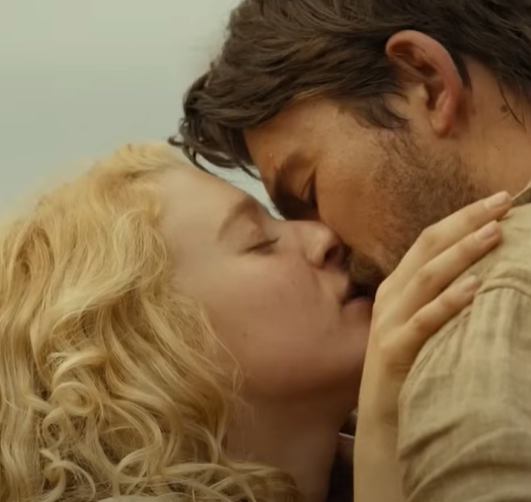
In the aftermath, Alex bravely pleaded Spencer’s case, confirming Arthur’s treacherous act. Even Jennifer, risking her own standing, corroborated Alex’s truth. But Arthur’s father, a powerful figure with royal connections, wielded his influence mercilessly. He dismissed all witness accounts, ordering Alex confined to her quarters and Spencer removed from the ship. Despite the Captain’s acknowledgment of Spencer’s self-defense, royal decree superseded all. The legality of Spencer and Alex’s marriage, performed in international waters, was questioned, a final, cruel attempt to invalidate their union. Spencer refused to leave without Alex, his demand met with the cold reality of royal authority.
The scene of their forced separation was a punch to the gut, a masterclass in heart-wrenching drama. Alex, escaping her confinement, ran desperately to the ship’s rail as Spencer was lowered in a dinghy. Their desperate cries across the widening expanse of water echoed the true tragedy of their situation: a love so profound, torn apart by forces beyond their control. “I will come to you! Where do I go?” Alex screamed, her voice cracking with anguish. “Bozeman! I will meet you in Bozeman, Montana!” Spencer yelled back, a final, desperate promise delivered against the backdrop of crashing waves and fading hope. It was a cliffhanger of epic proportions, leaving audiences breathless and emotionally shattered, but also fiercely hopeful for their inevitable reunion.
The saga of Spencer and Alex in “1923” is more than just a love story; it’s a testament to the enduring power of connection against all odds. Their journey, marked by danger, defiance, and profound devotion, is a thrilling exploration of what it means to truly choose another, to fight for a shared future, no matter the cost. As Spencer now embarks on the perilous journey to Bozeman, and Alex navigates the treacherous waters of societal disapproval and familial power, audiences are left to ponder: Can a love forged in such fire truly conquer distance, destiny, and the machinations of a powerful world determined to keep them apart? The answer, as the next chapter of “1923” unfolds, promises to be as dramatic and unforgettable as their journey thus far.