In the rugged, unforgiving world of Taylor Sheridan’s “Yellowstone,” peace is a fleeting illusion, especially when two formidable forces collide. Fans of the Dutton saga are still reeling from an unforgettable sequence that shattered the fragile domestic facade of the Yellowstone Ranch, transforming a tense dinner party into a brutal, no-holds-barred brawl between two of the series’ most polarizing female characters: the acid-tongued Beth Dutton (Kelly Reilly) and the uncompromising environmental activist Summer Higgins (Piper Perabo). What began as a simmering clash of ideologies over a plate of venison escalated into a raw, visceral spectacle of physicality, leaving viewers breathless and questioning the very nature of civility on the ranch.
The episode, which aired to massive anticipation, promised an uneasy alliance, or at least a temporary truce, between John Dutton’s (Kevin Costner) controversial new flame, Summer, and his fiercely protective, often-unhinged daughter, Beth. Summer, a vegan activist whose principles stand in stark opposition to the Duttons’ ranching lifestyle, found herself transplanted from the concrete jungles of protest lines to the wild heart of Montana. Her presence on the ranch, particularly at the dinner table, was always going to be a lit fuse. But few could have predicted the explosive detonation that followed.
The scene opens with a seemingly domestic tableau, albeit one heavily laced with Beth’s signature sarcasm. John Dutton’s loyal, gruff chef, Gator (Gabriel “Gator” Guilbeau), presents an array of wild game – venison, roast duck, and even dove – harvested from the very land Summer is fighting to preserve. Beth, ever the instigator, sets the tone immediately, mocking Summer’s dietary restrictions with a smirk that promised trouble. “So, Gator, what did you kill for dinner this evening?” she purred, her eyes glinting with malicious amusement. Summer’s response, a thinly veiled insult about Beth’s unexpected presence – “Sorry, I didn’t know you’d be joining us out of. Picked a different everything. Had I known” – only served to sharpen Beth’s already whetted blade.
The verbal volley quickly escalated into a full-scale assault on Summer’s principles. Beth, masterfully dissecting Summer’s moral high ground, pressed for “a vegetarian option? Even a vegan option, please.” When Gator, caught in the crossfire, seemed at a loss, Beth’s chilling suggestion to “just give her what we feed the horses” cemented her intent to humiliate. Summer, however, proved no shrinking violet. Her protests over the ethics of consuming wild game – the tragic tale of ducks that “mate for life,” the incredulous revelation that the “bird of peace,” a dove, was on the menu – were met with Beth’s cutting rejoinders, each one designed to poke at Summer’s vulnerabilities. “At least something at this table does [mate for life],” Beth sneered, delivering a personal blow that cut deeper than any dietary critique. Summer’s horrified realization that four doves were slaughtered for a single serving further inflamed her outrage. “You’re serving the fing bird of peace for dinner,” she spat, her voice laced with disgust.
The tension became unbearable, a thick, suffocating cloud over the table. Even John, usually adept at navigating family squabbles, found himself unable to defuse the situation. Summer’s plea, “This is just so fing uncomfortable. Can we eat,” fell on deaf ears. It was then that John, with a characteristic mix of paternal weariness and calculating pragmatism, made a suggestion that would seal Summer’s fate for the evening: “Summer? Let’s you and I take a walk.”
What followed was a masterclass in baiting from Beth. Knowing full well John’s intentions, she hijacked the invitation, asserting her dominion: “Yeah. Maybe I can help educate you on our differing ways of life, our different cultures and different value systems.” Summer, emboldened by righteous indignation, accepted the challenge, perhaps underestimating the true meaning of a “walk” with a Dutton. “You have values? Let’s take a walk,” she retorted, sealing her own doom.
Rip Wheeler (Cole Hauser), the loyal ranch foreman and Beth’s long-suffering husband, sensing the impending catastrophe, attempted to intervene. “Whoa whoa whoa. Girls,” he cautioned, a futile effort. Beth, ever one to assert her adult status and power, scoffed, “Girls? Do you see a girl in this room, dad?” Her cold, dismissive “After you,” followed by Summer’s defiant “Not on your life,” set the stage for the physical confrontation.
As the two women stalked off into the dim Montana twilight, Rip’s concern was palpable. “Sir, do you want me to go after them?” he asked John, who, in a classic Dutton move, remained impassive. “I think that’s a terrible idea, Rip,” John replied, the hint of a smirk playing on his lips. He understood that some battles had to be fought, some lessons learned the hard way. His advice to Gator – “let’s eat while we still can” – spoke volumes about his detached amusement and the inevitability of the impending clash.
Outside, under the vast, indifferent sky, the true nature of the “walk” became clear. Summer, still clinging to the notion of a metaphorical discussion, was quickly disabused of her naivety. Beth wasted no time in unleashing a torrent of vitriol, each word a psychological punch. “Familiar position for you,” she taunted, implying Summer’s prior incarceration. “You smug, spoiled, 40 year old adolescent. You’re everything that’s wrong with this place.”
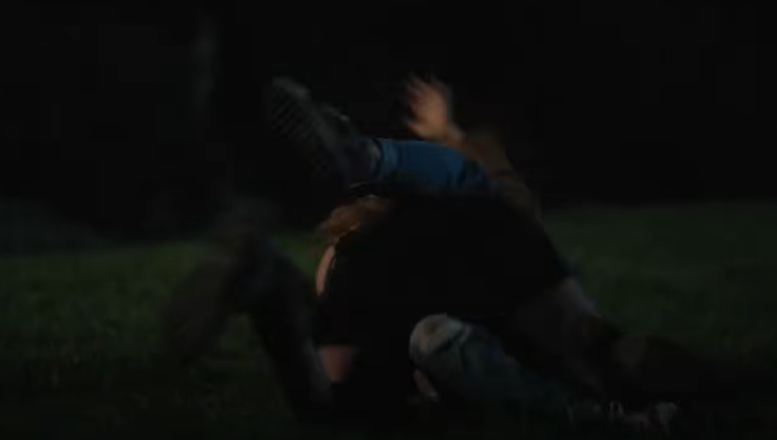
Summer, despite her moral superiority, was not above delivering a low blow, aiming at the very core of Beth’s existence: “The only thing wrong with this place is you’re in it.” And with that, the last vestiges of civility evaporated. The two women lunged at each other, the raw, unbridled fury of their ideological and personal hatred manifesting in a chaotic ballet of punches, kicks, and grappling.
The fight itself was a jarring, visceral spectacle, devoid of the stylized choreography often seen in television brawls. It was messy, desperate, and terrifyingly real. Beth, leveraging her street-fighting instincts honed by years of defending the Dutton name, declared her advantage with a chilling warning: “Nine years of jujitsu, bitch.” But Summer, surprisingly resilient and packing a surprising punch, shot back, “I grew up with three brothers, you fing hippie!” This wasn’t a one-sided beatdown; it was a desperate struggle for dominance, a primal scream of two worlds colliding.
Back at the ranch house, John and Rip listened to the cacophony of grunts, shouts, and blows with differing reactions. John, sipping his drink, seemed to regard it as a necessary cleansing, a purging of tensions. “You know what’s going to happen, don’t you, sir?” Rip asked, already resigned. “I suspect it’s happening right now, Rip,” John confirmed, adding, “I’m sick of listening to it. Get it out of their system.” But Rip, ever the realist, understood the futility of this hope when it came to Beth. “Nothing gets out of your daughter’s system, sir,” he stated, a grim testament to Beth’s enduring rage.
Ultimately, the fight was broken up, but not before both women bore the marks of their violent encounter. Beth, with a final, cutting remark – “Do you know how stupid you both look? Oh, you look ridiculous” – asserted her psychological victory, even as her own appearance was surely disheveled.
The brutal dinner party brawl between Beth and Summer was more than just a fight; it was a microcosm of the entire “Yellowstone” narrative. It underscored the unyielding nature of the Dutton family’s defense of their way of life, Beth’s unparalleled loyalty, and the sheer impossibility of outsiders truly integrating without being irrevocably changed by the ranch’s harsh realities. For Summer Higgins, the confrontation was a brutal awakening to the Duttons’ world, a world where principles are often secondary to survival and where ideological battles are sometimes settled with fists, not words. As the dust settles, one question lingers: what will be the lasting impact of this savage showdown on Summer’s future at the Yellowstone, and indeed, on the already volatile dynamics of the Dutton family? Fans can only brace themselves for the inevitable aftershocks.