The journey west across the unforgiving American plains in Taylor Sheridan’s acclaimed “Yellowstone” prequel, 1883, is not merely a tale of migration; it is a visceral, often brutal, masterclass in the unwritten rules of survival. Streaming exclusively on Paramount+, the series thrusts viewers into the crucible of the late 19th century, where the promise of a new life is shadowed by the constant threat of death. It’s a world where the very ground beneath your feet can be an enemy, and where ignorance is a swift, merciless killer. A pivotal early scene, stark in its simplicity yet profound in its implications, lays bare the fundamental dangers facing a desperate band of European immigrants, guided by two world-weary frontiersmen who understand that knowledge, however grim, is their only currency.
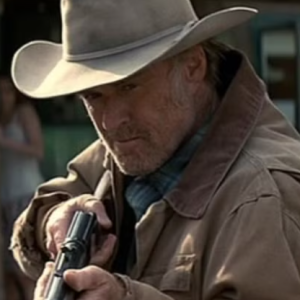
Leading this reluctant education are Shea Brennan (Sam Elliott), a Pinkerton agent scarred by loss and hardened by the land, and his stoic, pragmatic companion Thomas (LaMonica Garrett). Their charges, largely German-speaking immigrants fresh off the boat, arrive with little more than the clothes on their backs and an almost childlike naiveté regarding the perils of the American wilderness. For them, the dream of freedom and fertile land has blinded them to the raw, untamed reality that stretches before them. It is here, under the vast, indifferent sky, that Brennan is forced to deliver the first, most critical lesson: the land itself is actively trying to kill you.
The scene opens with Brennan, his voice a low growl of weary authority, holding aloft a coiled, silent threat. “This is a rattlesnake,” he warns, his words translated into German by the ever-patient Thomas. The implications are chilling, delivered with the bluntness of a man who has seen too much. “They hide under logs, and under the rocks. At night, if it’s cold, they will look for warmth. And if you’re sleeping on the ground, that warmth is you. A bite will kill you.” The raw terror in the immigrants’ eyes is palpable. They’ve likely never encountered such a creature, let alone understood the insidious nature of its hunt for warmth. This isn’t just a biological fact; it’s a grim prophecy for those who fail to heed the warning. It immediately establishes the stakes: survival on this journey isn’t about grand acts of heroism, but about meticulous attention to mundane, yet lethal, details.
Brennan continues his grim tutorial, moving from the overtly deadly to the insidiously debilitating. “This is poison oak and poison ivy,” he explains, holding up a leafy branch. “It won’t kill you, you’ll just wish you were dead. Do not touch it. Do not walk in it.” While not a direct threat to life, the prospect of weeks or months of agonizing, itching discomfort on a journey of thousands of miles highlights another cruel facet of frontier survival. It’s not just about avoiding immediate death, but about enduring conditions that can break the spirit, compromise strength, and leave one vulnerable to other, more lethal threats. The cumulative effect of such discomfort could easily spell the end for the unprepared.
Yet, perhaps the most critical, and comically challenging, lesson comes when a young immigrant asks, “What else?” Thomas, ever the practical one, responds simply, “Water.” This leads to Brennan’s stern directive: “Do not drink water from the ground. When we camp, we will choose a latrine away from the water source.” The word “latrine” hangs in the air, a linguistic and cultural chasm. The bewildered immigrants murmur in German, prompting Thomas to offer increasingly elaborate synonyms – “Powder room. Water closet.” – until he finally relents and whispers, “Toilette.” The simple French word, easily understood, elicits a collective gasp of dawning comprehension: “Ah. Toilette.”
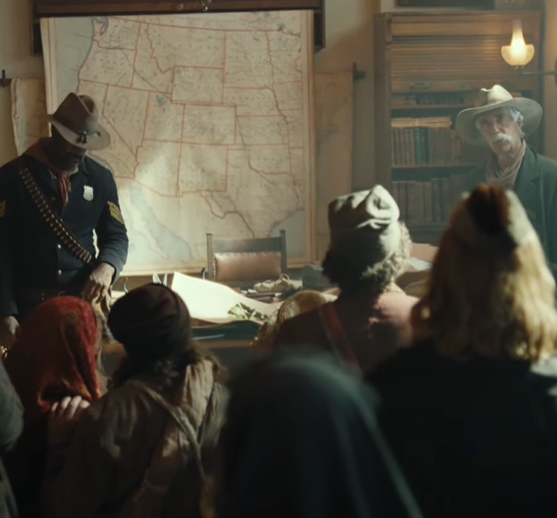
This moment, though humorous, serves as a poignant microcosm of the entire undertaking. The sheer gap in basic understanding between the seasoned Americans and the wide-eyed Europeans is staggering. What is common sense to Brennan and Thomas – the absolute necessity of preventing water contamination from human waste – is an alien concept to people accustomed to established towns and plumbing. It underscores the incredible vulnerability of these travelers, not just to the natural elements, but to their own profound inexperience. Clean water, as Brennan knows, is paramount. A single contaminated source could wipe out their entire party through disease, a far more insidious killer than a rattlesnake. It’s a subtle nod to the historical realities of westward expansion, where dysentery and cholera often claimed more lives than Native American raids or wild animals.
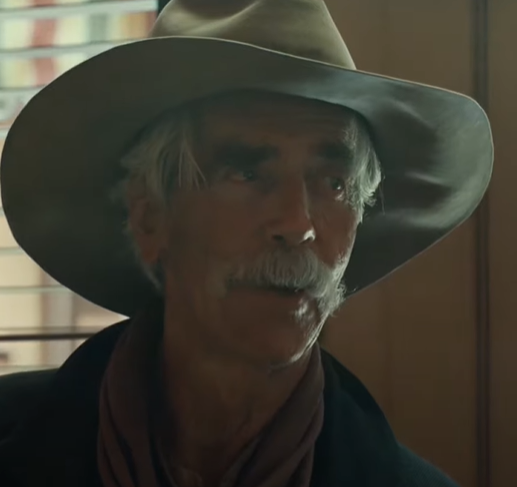
As Brennan’s harsh but vital lesson concludes, the scene shifts, revealing the quiet, watchful presence of James Dutton (Tim McGraw). The patriarch of the Dutton family, who will eventually found the Yellowstone Ranch, stands apart, observing the desperate, bewildered crowd. His presence is a stark contrast to the immigrants; he is a man of the land, rugged and self-reliant, embarking on his own odyssey with his family. His introduction to Shea Brennan is understated but loaded with unspoken understanding.
Brennan, pragmatic as ever, offers James a position, a paycheck: “Pay is a hundred a month.” But James, a man driven by a singular purpose – the protection of his own – refuses the conventional arrangement. “No. I don’t want your money. I ain’t working for you. I’m just riding with you.” This refusal speaks volumes. It establishes James not as a subordinate, but as an equal partner, an independent force. He’s not motivated by wages but by shared necessity and mutual respect for a fellow survivor. This alliance, forged not in friendship but in the shared grim reality of the frontier, will be foundational to their collective journey. It also hints at the future Dutton ethos: fierce independence and a reliance on one’s own capabilities.
The conversation deepens as James, ever practical, asks, “How many women in your group?” Brennan’s response carries the weight of his immense responsibility and the vulnerability of his charges: “It’s all women in my group. And a five-year-old boy.” This simple exchange highlights one of the most agonizing burdens of the trail: the protection of the weakest. Women and children were often the most susceptible to the myriad dangers of the journey – from exposure and disease to starvation and violence. Brennan’s frank admission of his group’s composition underscores the immense challenge he faces, a challenge that James, with his own wife Margaret (Faith Hill) and children by his side, deeply understands.
This early sequence in 1883 is more than just exposition; it’s a thematic cornerstone. It meticulously establishes the central conflict of the series: humanity versus the unforgiving wilderness. It paints a vivid picture of the sheer ignorance and vulnerability of those who dared to dream of a better life in an untamed land. It introduces the complex, often gruff, leadership of Shea Brennan and Thomas, whose jaded wisdom is the only thing standing between their charges and oblivion. And crucially, it cements the foundational alliance between Brennan and James Dutton, two strong, independent men who, despite their different paths, are united by the brutal realities of survival and the desperate hope of forging a future.
As the wagon train moves forward, these initial lessons will resonate with every stumble, every illness, every loss. 1883 refuses to romanticize the frontier; instead, it offers a raw, unfiltered look at the grit, the suffering, and the sheer force of will required to conquer an unknown world. The rules of survival, articulated so bluntly in this scene, are not abstract concepts; they are the very commandments by which life and death are determined, shaping the destiny of an entire generation and laying the arduous groundwork for the legendary Dutton family legacy on the sprawling plains of Montana. The journey has just begun, and the deadliest lessons still lie ahead.