In a breathtaking display of courage, medical expertise, and sheer determination, paramedic Iain Dean and his Holby City colleagues found themselves at the epicenter of a high-stakes rescue that spiraled into the unmasking of a major drug operation. What began as a perilous extraction from the dizzying heights of a construction crane quickly escalated into a race against time, not only to save a life but to expose a chilling secret hidden in plain sight.
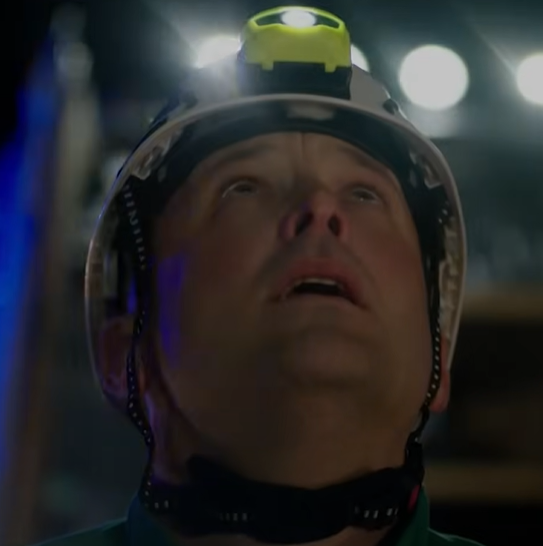
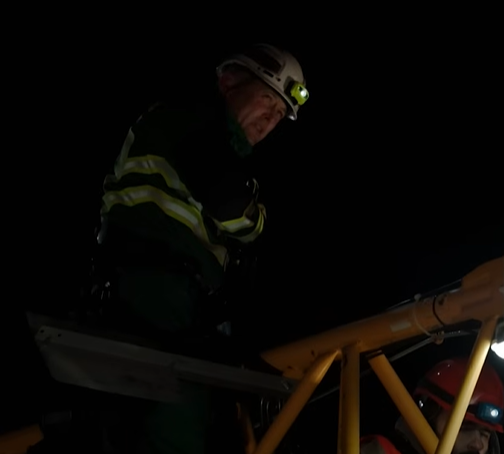
The episode opens with the heart-stopping sight of Iain Dean, a veteran paramedic known for his daring approach, perched precariously hundreds of feet above the ground. His mission: to extract a trapped worker, later identified as Haz (referred to initially as Glen), from a towering crane. The scene crackles with tension as Iain, guided by the anxious voices of his colleagues Indie and Teddy below, urges Haz, “Come on, Iain. You’re nearly there!” The sheer physical exertion is palpable as Iain battles the elements and the clock, with Haz groaning in pain, describing an “elephant on my chest”—a stark indicator of his critical condition. The wind whips around them, a furious unseen antagonist adding to the already immense danger.
As Iain finally reaches Haz, the immediate priority shifts to medical intervention. Haz, a young father of a two-month-old son he’s never met named Bilal, is struggling to breathe. The team, including the highly professional Tim, prepares for a rapid descent. However, a critical problem emerges: the essential drug, atropine, is missing from Iain’s kit. Iain, ever resourceful but perhaps too quick to improvise, admits he had no atropine and resorted to a “DIY mix” of adrenaline. This small, seemingly insignificant detail plants a seed of doubt and sets the stage for a later, more profound revelation.
The extraction kit is assembled, but the intensifying wind makes the descent treacherous. Tim instructs Indie, the junior paramedic, to go down with Haz, entrusting her with the crucial task of administering the improvised adrenaline mix. It’s here, amidst the chaos and urgency, that Indie’s keen observation skills come into play. As she handles the equipment, she remarks, “It feels kind of heavy. I think there’s something in this.” Her instincts prove chillingly accurate. A sharp tug, a clatter, and the shocking truth tumbles out: the seemingly innocent doll’s heads, part of the extraction kit, are not just props—they are meticulously crafted containers, each “full of heroin.”
The discovery sends a jolt through the team. Tim, ever the stickler for protocol, immediately points out the grave implications: “We can’t administer anything outside our PGD [Patient Group Direction].” The question of the missing atropine resurfaces, leading Iain to quickly cover his tracks, claiming he “dropped it over the side” of the crane. The focus, however, is now squarely on the patient. The medical emergency, coupled with the astonishing drug find, creates a maelstrom of professional and ethical dilemmas for the paramedics.
Back on solid ground and speeding towards the hospital in the ambulance, Haz’s condition rapidly deteriorates. “Blood’s obstructing his airway!” Tim shouts, as the patient fights for every breath. The ambulance becomes a blur of controlled chaos, with Tim issuing precise commands for suction and medications, while Indie works tirelessly to clear Haz’s airway. The urgency is amplified by the sheer distance to the hospital—twenty minutes, an eternity for a patient in such critical distress.
With no time to wait for a Helicopter Emergency Medical Service (HEMS) team, Tim makes the crucial decision: Haz needs an Oropharyngeal Airway (OPA) inserted immediately. This delicate procedure, normally performed with precision in a controlled environment, must now be carried out in a fast-moving ambulance. Iain, despite his earlier evasiveness, rises to the challenge, assisting Indie with a jaw thrust as she tries to navigate the obstruction. “I can’t see. Is that a tooth fragment in there?” she asks, highlighting the extreme difficulty. But their combined expertise prevails. With Sue, the ambulance driver, maintaining a steady course at a dizzying 70mph, the OPA is successfully placed. “That’s in,” Iain confirms, a collective sigh of relief palpable as Haz’s oxygen saturation levels begin to improve.
The immediate crisis averted, the story quickly shifts to the astonishing impact of their discovery. A news report flashes across a television screen, praising the paramedics for “helping to keep Holby streets clean.” The police officer on the news describes the heroin haul as “quite simply, the strangest and largest… they had ever seen.” The public sees heroes; inside the ambulance station, the reality is more complex.
Indie, the true unsung hero of the drug bust, basks briefly in the glow of Jacob’s praise: “Take a bow, that girl. I just cracked a major drug ring.” Her quiet pride is juxtaposed with Iain’s more boisterous self-congratulation, “I’m a hero! I’m gonna get a reward!” Jacob playfully teases Iain, mimicking his bravado: “‘Easy. I’m just doing my job! I’m Iain Dean, I love climbing cranes. Hello, Faith. I like rescuing people, me!'” The camaraderie, however, is about to be shattered.
In a quiet, understated moment that carries immense weight, Indie drops a bombshell. “Oh, I just found this,” she says, holding up a small, sealed bag. “I’m guessing it’s the atropine that Indie forgot to put in all the drug bags.” The room falls silent as the truth dawns on everyone. It’s not just atropine; it’s the atropine, the one Iain claimed he dropped from the crane. “So it’s the atropine that Iain lied to us about, when he told us he dropped it off a crane,” Tim states, his voice heavy with disappointment. Iain’s carefully constructed lie unravels in front of his colleagues, leaving him exposed.
The revelation elicits a swift and decisive reaction from Jan, the team’s stern but fair boss. “Don’t Jan me!” she snaps at Iain, her disappointment palpable. “Having one crew member that I can’t trust is more than enough, thank you.” Iain’s deception, a breach of professional trust, casts a dark shadow over his heroic actions. Jacob attempts to mediate, urging Jan to let go of a past mistake, emphasizing the team’s strength. But for Jan, trust is paramount, and Iain’s lie is a direct assault on that foundation.
Yet, despite the internal turmoil, the impact of Iain’s actions, both heroic and flawed, echoes far beyond the ambulance bay. The episode culminates in a profoundly moving scene: Iain visits Haz in the hospital. Haz, now recovering, his breathing steady thanks to the stent put in, expresses his gratitude: “I’m breathing. Thanks to you.” It’s a powerful moment of connection between rescuer and rescued.
The scene gains further emotional depth with the arrival of Haz’s wife and, finally, his two-month-old son, Bilal. “This must be Bilal,” Iain says softly, his usual bravado momentarily melting away as he gazes at the infant. The reunion of father and son, made possible by Iain’s perilous rescue, transcends the earlier drama and ethical conflicts. Haz’s wife expresses her heartfelt thanks in Urdu, a poignant reminder of the diverse lives they touch. Iain, initially awkward, is visibly moved as he interacts with Bilal, coaxing a smile from the baby. “You like me, hey?” he asks, a genuine warmth in his voice.
The episode closes with Haz’s powerful and resonant declaration, his eyes fixed on Iain: “You are the only reason my son still has a father.” It’s a moment of profound redemption for Iain, a testament to the fact that despite his human frailties and professional missteps, his core purpose—saving lives—remains intact. The dramatic “Casualty” narrative, therefore, weaves together not just a thrilling medical emergency and a shocking criminal bust, but also a complex exploration of trust, integrity, and the enduring human impact of those who stand on the front lines, ready to answer the call, no matter the cost.