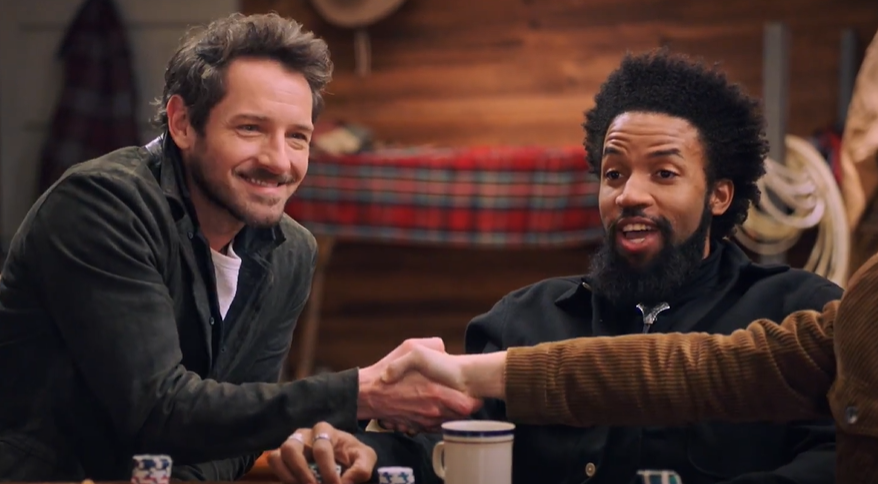
Paramount Network’s “Stories from the Bunkhouse” offers fans a rare, unvarnished glimpse behind the curtain of the most formidable ranch on television: the Yellowstone Dutton Ranch. In a candid Episode 18, the cast—Denim Richards (Colby), Jefferson White (Jimmy Hurdstrom), Ian Bohen (Ryan), and Forrie J. Smith (Lloyd Pierce)—peeled back the layers of Yellowstone’s searing drama, revealing not only the tight-knit camaraderie of the bunkhouse but also the brutal realities, unwavering loyalties, and existential threats that define the Dutton dynasty.
From the outset, the conversation swung between the lighthearted and the profoundly dramatic, a testament to the show’s unique blend of gritty Western realism and compelling character arcs. The bunkhouse boys kicked off with a hilariously botched attempt at a “Yellowstone” jingle, their playful banter setting a deceptively casual tone. “Three lonely bunkhouse boys, alone together at a poker table,” mused Jefferson White, capturing the isolated but deeply bonded existence of their on-screen personas. This camaraderie, however, belies the raw violence and moral quandaries that relentlessly assault their lives.
The Unconventional Nuptials: Rip, Beth, and the Meaning of Family
A significant portion of the discussion naturally gravitated towards the eagerly anticipated wedding of Rip Wheeler and Beth Dutton – a union as tempestuous and passionate as the Montana landscape itself. The actors pondered the scale of the ceremony: would it be a grand affair or a fiercely private moment? Denim Richards speculated, with a chuckle, that the bunkhouse boys might not even be invited, perhaps relegated to catering duties, clad in “matching white shirts with the cuffs” and “just the cummerbund.” This playful imagery underscored the unusual nature of Rip and Beth’s relationship, one forged in fire and loyalty, far removed from societal norms.
The question of Beth’s maid of honor ignited further debate. Given Beth’s famously abrasive persona, traditional choices seemed unlikely. The cast mused over Monica, with whom Beth shared a surprisingly moving scene in Season Two, or even the formidable Angela Blue Thunder. But it was Ian Bohen’s suggestion that Beth might pick “something really weird like Kayce to be her bro of honor” that truly highlighted the unconventional familial ties within the Dutton orbit. These discussions weren’t just idle speculation; they underscored the profound and often twisted definitions of “family” on the ranch, where loyalty often runs deeper than blood.
Similar playful hypotheticals touched upon other bunkhouse romances. The prospect of a “Teeter and Colby” wedding sparked the fan-favorite ship names “Ceeter” and “Tolby,” cementing the audience’s emotional investment in even the newest arrivals. Even Jimmy and Mia’s potential nuptials were teased, with Ryan humorously “betraying” Colby by declaring himself Jimmy’s best man. These moments of levity, however, served as brief respites from the pervasive tension that permeates every corner of the Yellowstone.
The Brand’s Unforgiving Scars: Walker’s Reckoning
The conversation swiftly pivoted to one of Season Three’s most shocking and pivotal moments: the unexpected return of Walker, the enigmatic musician who had dared to cross Rip and the Duttons. His initial “death sentence” in Season Two had been a brutal display of Western justice, driven by a dual transgression: his refusal to follow orders and, more unforgivably in Rip’s eyes, his illicit dalliance with Beth. “I think it’s his refusal to follow orders exacerbated by his dalliance with Beth,” Ian Bohen affirmed, encapsulating the volatile cocktail of disloyalty and personal affront that sealed Walker’s fate.
The actors marveled at Rip’s uncharacteristic patience with Walker, a rare display of mercy from the typically ruthless foreman. Cole Hauser, who embodies Rip with chilling intensity, had reportedly often wanted to “kill Walker” on set, reflecting Rip’s deep-seated rage. Yet, Rip repeatedly gave Walker ultimatums, pushing him to honor the brand. “Rip, I think, is actually by Rip standards, shown Walker tremendous mercy and patience,” noted one cast member. But there is a line, an unspoken code that, once violated, demands absolute retribution.
The discussion honed in on the sacred, immutable power of “the brand”—the Yellowstone’s indelible mark of allegiance, an oath more binding than any legal contract. As Jimmy Hurdstrom (Jefferson White) grimly observed, “You get one chance with that brand.” The brutal fate of Fred, who dared to strike a branded man, served as a chilling reminder: “Fred hit a branded man. He’s gone. That was it.” Walker’s refusal to obey orders, coupled with the unforgivable sin of touching Beth, cemented his status as a marked man. The actors’ unanimous “Team Rip” allegiance underscored the ranch’s ethos: in the unforgiving world of the Yellowstone, loyalty is paramount, and betrayal has fatal consequences.
Justice Redefined: Kayce’s Moderation vs. Dutton Absolute
The “Team Rip vs. Team Walker” debate naturally broadened into a fascinating philosophical discussion about justice itself. For John Dutton and Rip, justice is absolute, black and white, devoid of nuance. Problems are solved definitively, often with extreme prejudice. “For JD and for Rip, justice is absolute and it’s final and there’s no gray room,” a cast member noted. This harsh pragmatism ensures the ranch’s survival in a predatory world.
However, Kayce Dutton, played by Luke Grimes, often serves as the moral compass, wrestling with the ethical implications of their violent reality. Despite committing terrible acts, Kayce maintains, “I’m not a murderer.” He strives to introduce “reason” into a context where it’s often abandoned, seeking a “different way” to manage the ranch’s volatile existence. “Team Kayce” was championed by some of the actors, representing a yearning for moderation and a more tempered approach to the ranch’s perennial conflicts. Yet, as Forrie J. Smith (Lloyd) pointed out, in a world where “things are escalated,” there’s often no time for the luxury of finding a “gray area.” Rip’s decisive, if brutal, actions at least “get things done.”
The Unspeakable Act: The Creek Scene and the Price of Ranch Life
The discussion of the ranch’s brutal justice culminated in a harrowing recounting of the infamous creek scene, where Wade Morrow and Clint savagely stomped on branded Yellowstone hands, including Teeter, in the freezing water. The actors vividly recalled the grueling conditions of filming, emphasizing the bone-chilling cold of the actual creek and the terrifying realism of horses stomping around their submerged bodies. “You’re just holding your breath, floating down the creek,” one described, conveying the sheer adrenaline and discomfort involved.
This brutal sequence served a critical narrative purpose. The cast highlighted the shocking nature of seeing an innocent character like Teeter, known for her free spirit and “never has any real mean bone in her body,” subjected to such senseless violence. This act, they agreed, justified any retribution that would follow, ensuring that “the audience should go, ‘yeah, they’re worthy of whatever comes to them.'” The scene was not just a plot device; it was a visceral demonstration of the stakes involved in the fight for the ranch, solidifying the audience’s understanding that no act of violence is too extreme for the Duttons when their land and their people are threatened.
A Kingdom on the Brink: The Enduring Battle for Legacy
The conversation ultimately delved into the very heart of Yellowstone: the relentless, existential battle for the ranch’s survival and the complex definition of “family” within the Dutton dynasty. With Tate as the “only blood descendant,” the future of the lineage hangs precariously. John Dutton’s steadfast refusal to sell, despite Beth’s pragmatic pleas to “sell, we’re out,” speaks volumes about his unwavering commitment to a promise made generations ago. “No pride, honey. It’s just I made a promise. I’d rather lose it than break it,” he declares, encapsulating the Dutton patriarch’s almost suicidal dedication to his legacy.
The question posed by a reporter in Season Two—”Hey, this isn’t a kingdom. Your dad’s not a king”—echoed through the bunkhouse. It challenges the traditional monarchic lineage (John to Kayce to Tate) by asking: who truly constitutes family? The actors passionately argued that loyalty, sacrifice, and the willingness to die for the ranch, as demonstrated by Rip, Lloyd, and all branded men, should count for something. “Doesn’t that mean that they’re family?” they challenged, pushing against the rigid confines of bloodline.
The show’s brilliance, they concluded, lies in this fascinating collision of identities. John Dutton fights for his immediate, blood family, an almost monarchic lineage. Yet, across the valley, Thomas Rainwater wages a parallel war, fighting not for a nuclear family, but for his entire tribal community, for a sense of identity tied to millennia of ancestry. “This is what the show’s about,” Jefferson White summarized. Two formidable leaders, fighting for the “same thing for very different reasons,” their decisions shaped by profoundly different definitions of land, legacy, and loyalty.
“Stories from the Bunkhouse” Episode 18 offered far more than just behind-the-scenes anecdotes. It provided a powerful, unscripted exploration of Yellowstone’s core themes: the enduring power of loyalty, the brutal realities of Western justice, and the unrelenting fight for a legacy that transcends blood. As the series continues to unfold, these complex dynamics ensure that the Yellowstone Dutton Ranch remains a captivating, volatile, and unforgettable battleground for the soul of the American West.