Holby City Hospital became a terrifying battleground this week as Casualty delivered one of its most potent and painfully relevant episodes to date: “Extremists Storm The Hospital!”. In a chilling exploration of radicalization, prejudice, and the unwavering dedication of medical professionals, the BBC drama pushed boundaries, leaving viewers on the edge of their seats and emotionally shattered.
From its opening moments, “Extremists Storm The Hospital!” signalled a departure from typical weekend drama. A haunting, disembodied monologue, laced with the insidious rhetoric of casual bigotry – “I’m not racist, but why are there only Polish working here?… I’m not racist, but why isn’t my child allowed to sing Christmas carols at school?… I am racist.” – set a disquieting tone. This stark, unflinching prelude underscored the deep-seated prejudices simmering beneath society’s surface, prejudices that would violently erupt within the seemingly safe confines of Holby City Hospital’s Emergency Department.
The episode masterfully wove together multiple narrative threads, gradually tightening the noose around the unsuspecting ED staff. At the heart of the escalating tension was Ibrahim, a figure consumed by a cocktail of personal tragedy and radicalized ideology. We first encountered the echoes of his past, a tragic road traffic accident at a bus stop where a mother and child lost their lives. The stark police report detailed “massive chest trauma” and the chilling reality that “They were both dead at the scene.” This incident, initially shrouded in ambiguity, was soon revealed to be Ibrahim’s own devastating act: “Escaping the scene of a crime and murdering a mother and child while doing so is no accident.” Yet, Ibrahim, a twisted architect of his own narrative, portrayed himself as a victim, later unleashing a chilling declaration of vengeance: “For killing my wife and my boy, you think Allah will honour you?” This dual identity – perpetrator of a heinous crime and a man driven by profound personal loss, albeit one he grotesquely twisted for his own ends – painted a complex and terrifying portrait of radicalization. He believed “they” (implying the “right-wing community” or the system he railed against) were responsible for his loss, justifying his escalating violence as a righteous fight “For Islam.”
The atmosphere in the ED, typically a crucible of stress, became suffocating with an unspoken dread. As reports surfaced of a “big noise among the right-wing community” – an individual targeted by extremists – being treated in the ED, a chilling inevitability settled in. The calm before the storm was shattered by the deafening crack of gunshots, sending shockwaves through the hospital corridors. Panic erupted. Doctors, nurses, and paramedics, accustomed to saving lives, found themselves in mortal danger, forced to make impossible choices.
The narrative escalated dramatically as Ibrahim and his heavily armed cohorts seized control. Their immediate objective: Mrs. Ellisson, the unsuspecting “right-wing” figure, taken hostage and led to the boardroom – a symbolic space of power now perverted into a chamber of terror. The sight of one of the extremists, Mairo, chillingly disguised as a nurse, highlighted the insidious nature of the threat, blurring the lines between helper and aggressor, safety and peril.
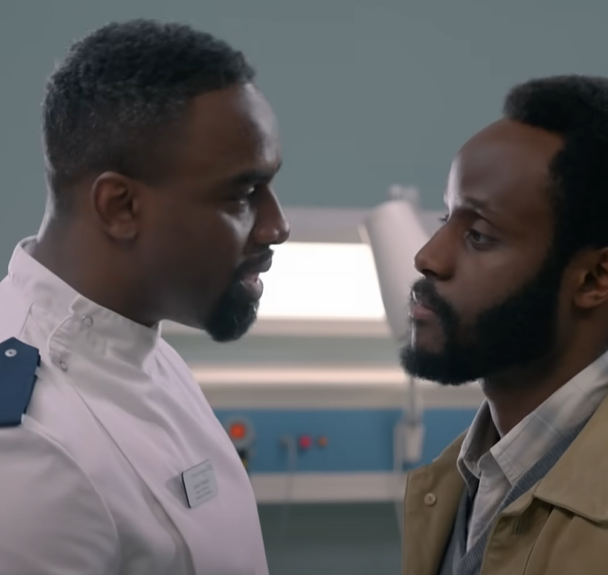
Within the confines of the boardroom, the episode reached its chilling dramatic zenith. The confrontation between Ibrahim and the compassionate Arshad was a searing battle of ideologies. “They attacked our Imam, destroyed our mosque,” Ibrahim raged, his words a desperate echo of perceived grievances. “We fought back. For Islam.” But Arshad, a voice of reason and true faith, bravely challenged the twisted logic. “And when did it become OK for us to kill? Or is there a part of the Quran that I missed?” His poignant plea, “But I was not at war. My family, my little boy was not at war!” resonated with the universal human desire for peace, starkly contrasting Ibrahim’s warped vision of holy war and sacrifice.
The tension mounted as police negotiators attempted to talk Ibrahim down. On the other end of the line, the armed unit prepared to storm the building, fully aware of the lives hanging in the balance. Meanwhile, Ibrahim’s unhinged confession to Arshad about the bus stop tragedy – “He killed a woman and a child, escaping the club. Wad’annan abubuwa. Sukan auku… They were Muslim. Would it be OK if they were white?” – revealed the depths of his depravity and the horrifying logic he employed to rationalize his own brutality, twisting even the deaths of fellow Muslims into a perverse justification for his actions.
The climax arrived with horrifying speed. Ibrahim, ready to execute Mrs. Ellisson, was momentarily stalled by Mairo’s shocking hesitation. “I don’t want to be responsible for killing a girl,” she whispered, a fragile crack in her hardened soldier façade, a glimmer of humanity amidst the darkness. “You are weak,” Ibrahim sneered, but the moment of doubt was enough. As police stormed the room, a single, devastating gunshot rang out.
In the ensuing chaos, it became tragically clear: it wasn’t an extremist, but one of Holby’s own who had fallen. Jacob, a beloved and dedicated member of the ED team, lay bleeding, shot amidst the crossfire. “No! No! He’s one of ours!” Connie Beauchamp’s anguished cry echoed the collective despair of a hospital under siege.
The episode pivoted abruptly from the terror of the attack to the frantic, heart-wrenching fight for Jacob’s life. Connie, ever the formidable leader, barked orders, her voice laced with an almost desperate urgency. “Get a stretcher, we need to get him in to resus! Louise, level one transfuser, please.” The ED, usually a place of controlled chaos, became a scene of raw, desperate heroism. Big Mac and the team worked with grim determination, their faces etched with fear and a fierce resolve to save their friend. Jacob’s barely audible whispers of “Our Father… who art in heaven…” as he fought for breath provided a poignant, almost unbearably intimate insight into his struggle and faith, even as Arshad offered his own comforting, peaceful “Asalaam alaykum wa rah matullah…” – a stark reminder of the true essence of their shared humanity, transcending the horrors just witnessed.

“Extremists Storm The Hospital!” was more than just a dramatic episode; it was a potent commentary on contemporary society. It bravely confronted the uncomfortable truths of radicalization, xenophobia, and the devastating impact of violence born from prejudice. It showed how extremist ideologies can warp minds and destroy lives, but also how compassion, courage, and an unwavering commitment to human life can shine through even the darkest of hours. The Casualty team, led by brilliant performances and a daring script, delivered a truly unforgettable and critically important piece of television, reminding us that even in the face of unimaginable terror, the spirit of humanity, embodied by the heroes of Holby, endures.