The high-stakes environment of Holby City’s Emergency Department is set to be rocked by a series of deeply personal and professional crises for its dedicated staff. As the team navigates the relentless demands of critical care, they will face unforeseen medical diagnoses, explosive family revelations, struggles for professional recognition, and intense relational pressures, each challenging their resilience and forcing them to confront their futures.
One of the most profound storylines unfolding centers on Stevie Nash, whose world is unexpectedly upended by a devastating medical diagnosis. Initially believing she was pregnant, Stevie was instead given the shocking news that she has a mass on her ovary. This week, the gravity of her situation becomes palpable as she struggles to process this life-altering information. Escaping the ceaseless chaos of the ED during her shift, Stevie attends a crucial gynaecology appointment, where further tests and scans confirm the need for a cyst removal. The procedure is not merely a treatment but a critical diagnostic step, as it will determine whether the mass is benign. Returning to work, Stevie attempts to compartmentalise the immense weight of this news, but the emotional and psychological toll is clear. This medical emergency, striking at the heart of her own health, is a poignant mirror to the daily struggles she witnesses in her patients, forcing her to experience vulnerability from a profoundly personal perspective. Her resilience will be tested as she grapples with the uncertainty, a stark reminder that even those who care for the critically ill are not immune to life’s most challenging curveballs.

Adding another layer of complexity to the department’s internal dynamics, Indie’s carefully constructed life is about to collide with a long-buried past. Having recently found financial stability through a generous gift from Gloria, Indie’s newfound peace is shattered when she and Jacob are dispatched to the local prison. The hostile, high-pressure environment is already a challenge, but their patient, Samuel, a prisoner stabbed in a fight, turns out to be more than just another case. Samuel fixates on Indie, probing her with personal questions about her family, a line of questioning that clearly unnerves her. Thrown off by the unexpected intrusion into her private life, Indie makes a critical error, accidentally worsening Samuel’s injury. In a surprising turn, Samuel covers for her when Jacob questions the mishap, hinting at a deeper connection. As they transport him to the hospital, the horrifying truth is revealed: Samuel is Indie’s estranged father. This shocking encounter forces Indie to confront a chapter of her life she has clearly tried to leave behind. The revelation raises immediate questions: What is the history between them? Why is he in prison? And how will this blast from her past, resurfacing in such a dramatic and public manner, impact her present life, her professional integrity, and her blossoming relationship with Jacob? The emotional fallout promises to be immense, potentially forcing Indie to re-evaluate her identity and her place in the world.
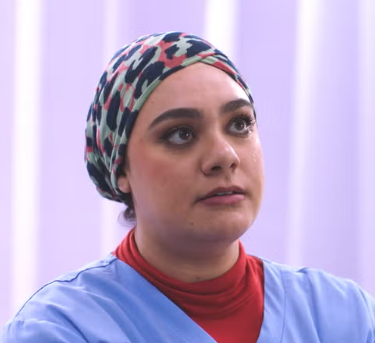
Meanwhile, the professional aspirations and frustrations of Rida Amaan come sharply into focus. In the wake of Tariq’s departure, Rida has been striving to adapt to Flynn’s new management style, a transition that has clearly not been without its challenges. Despite the difficulties, she has demonstrably met his ambitious new targets, a feat that has impressed even the observant Siobhan. However, Rida’s progress and confidence are undermined when her confident diagnosis for a patient is dismissed or simply not taken seriously by Russell. This perceived lack of respect and recognition deeply frustrates her. Later, confiding in Sean, Rida articulates a universal desire for any professional: she simply wants to be appreciated for her skills and efforts. This incident highlights a recurring theme within “Casualty” – the constant struggle for junior staff to have their voices heard and their expertise acknowledged within a hierarchical medical environment. Rida’s ambition and dedication are evident, but if her contributions continue to be undervalued, it raises a significant question: Is she seriously considering her future in the ED? Her disillusionment could lead her to seek opportunities where her talents are genuinely recognised, potentially charting a new course for her career away from Holby.
The pressures of management and resource allocation also weigh heavily on Flynn, who finds himself in a difficult ethical and financial dilemma. When Stevie, ever the patient advocate, approaches him with a plan to use an expensive medicine to buy more crucial time for a patient, Flynn is forced to refuse, citing departmental budget constraints. This decision, though likely made with the broader financial health of the ED in mind, undoubtedly disappoints Stevie, who prioritises immediate patient benefit above all else. However, as events unfold, Flynn gains a deeper understanding of the clinical rationale behind Stevie’s request, suggesting a moment of empathy and professional alignment. This understanding is immediately challenged when Russell, his formidable father-in-law, begins asking pointed questions about the request for the costly medicine. Flynn is thus placed in an unenviable position, caught between defending Stevie’s sound clinical judgment and succumbing to the financial and perhaps personal pressure exerted by Russell. This storyline underscores the complex administrative tightrope walked by ED managers, who must balance the needs of individual patients with the harsh realities of finite resources, all while navigating personal and professional relationships that can influence their decisions. His choice will define his leadership and potentially strain his relationships within the department.
Finally, the personal lives of Ngozi and Nicole are reaching a critical juncture, with their domestic tensions spilling over into their professional environment. As they prepare for Ngozi’s son, Obi, to move in with them that very day, the excitement is overshadowed by palpable tension between the couple at work. The integration of a child into a new household, especially within the demanding and unpredictable schedules of ED staff, presents a significant challenge. The high-pressure, emotionally charged atmosphere of the hospital invariably exacerbates any underlying personal stress, and it appears the situation is becoming increasingly overwhelming for them both. This storyline delves into the often-unseen struggles of frontline healthcare workers trying to maintain a semblance of personal life amidst the professional chaos. The impending move represents a significant test for their relationship. Will their partnership survive this latest, and potentially most defining, challenge, or will the combined weight of their personal and professional lives prove too much to bear, leading to a breakdown in their relationship?
As these intense storylines converge, the Holby City ED team faces a period of unprecedented personal and professional upheaval. Each character’s journey will explore themes of resilience, family, ambition, ethical decision-making, and the intricate balance between personal lives and demanding careers, promising a deeply engaging and emotionally charged future for the series.