In a truly heart-wrenching and emotionally charged episode of the beloved medical drama Casualty, viewers were plunged into a harrowing twenty-four hours that tested the very limits of compassion, professional duty, and the enduring scars of a troubled past. At the epicentre of this devastating narrative stood Cassie, a young woman teetering on the precipice of adulthood and abandonment, whose world crumbled within the sterile confines of Holby’s Emergency Department. What began as a routine, albeit frustratingly long, wait for medical attention for her foster mother, Maggie Findlay, quickly devolved into a desperate fight for life, uncovering long-buried secrets and forcing a beloved doctor to confront a past she desperately tried to outrun.
The episode opens with palpable tension. Eight agonizing hours have passed since Cassie and her foster mother, Maggie, arrived at Holby ED. Cassie’s frustration is a raw, understandable cry in the face of an overwhelmed system, her sharp demands for attention met with the weary, yet professional, apologies of the staff. “Eight hours we waited. Eight!” Cassie exclaims, her voice laced with the desperation of someone whose stability is fragile, and whose trust in the system is wearing thin. Yet, even amidst her own discomfort from a wrist injury sustained during a fall, Maggie, portrayed with subtle warmth and quiet wisdom, prioritizes Cassie. She finds a moment to pull aside Dr. Piper-Pickle, her eyes conveying a depth of understanding that hints at a long-standing, significant connection. With a gentle nudge, Maggie advocates for Cassie, urging the doctor to “talk to Cassie. That girl needs a push.” The casual, yet profoundly meaningful, observation that Cassie “reminds me of you. Terrible… Terrible tastes in music and all,” was the first poignant clue that the lives of these three women were intertwined in ways Cassie couldn’t yet fathom, and Dr. Piper-Pickle desperately hoped to forget.
The seemingly minor wrist injury, a fractured distal radius, quickly became secondary as the narrative took a terrifying turn. With no discernible warning, Maggie’s condition deteriorated with alarming speed. The sudden onset of acute anaphylaxis, a severe, life-threatening allergic reaction, sent shockwaves through the ED. The medical team, including the skilled Dr. Piper-Pickle and the focused Flynn, sprang into action, a whirlwind of adrenaline, commands, and desperate interventions. Aminophylline, adrenaline, and frantic chest compressions became the grim choreography of a life hanging in the balance. But despite their heroic efforts, the clock relentlessly ticked down. The haunting words, “She’s in cardiac arrest. Get on the chest,” were followed by the tragic, definitive pronouncement: “Time of death’s 14:13.” Maggie Findlay, the steadfast anchor in Cassie’s turbulent life, was gone.
The aftermath was a devastating tableau of raw grief. Dr. Piper-Pickle, her face etched with the professional stoicism of delivering the worst news, was met with Cassie’s shattering wails. The young woman’s world, already precarious, had been utterly destroyed. Maggie was more than a foster mother; she was Cassie’s last lifeline, the only beacon of stability she knew. As the reality of her loss set in, Cassie’s cries morphed into a primal scream of despair, a testament to the profound bond she shared with the woman who had opened her home and heart.
The tragedy deepened as the brutal realities of the foster care system came into sharp focus. With Maggie gone and Cassie set to turn eighteen tomorrow – the age at which foster children often “age out” of the system – there was “no available placement for her.” Despite the existence of the “Staying Put policy,” designed to ensure foster children can remain with their carers beyond 18, Maggie’s death rendered it null and void for Cassie. Her future, as discussed by social workers Siobhan and Nicole, was reduced to a cold, impersonal “room in a hostel.” The grim outlook spurred Nicole, a social worker clearly burdened by the systemic failures, to offer a piece of desperate, yet remarkably compassionate, advice to Cassie: “Call this number. Tell them you think you might be pregnant. They’ll move you to that unit. It’s nicer. It’s more central. Don’t actually get pregnant. They won’t boot you out when there’s no baby.” It was a stark illustration of the shocking lengths young people are forced to go to secure even a modicum of stability within a system seemingly designed to fail them.
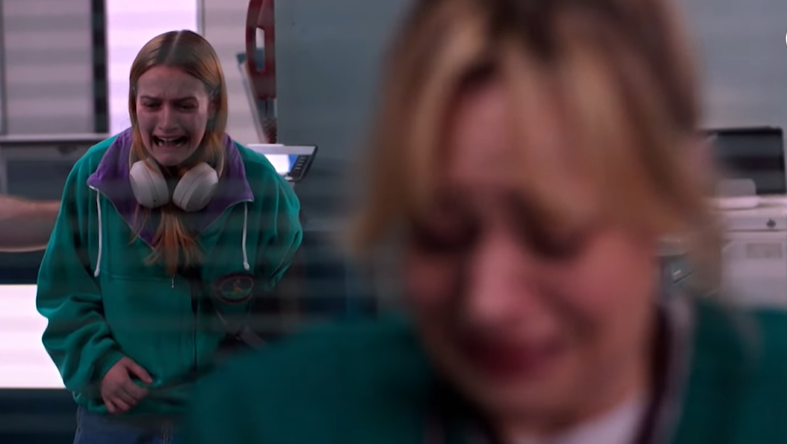
But it was in this moment of utter desolation that a shattering revelation emerged, one that linked Cassie’s desperate present to Dr. Piper-Pickle’s carefully constructed past. As Nicole spoke, Cassie’s gaze fixed on the doctor, recognition dawning in her grief-stricken eyes. “That’s where I know you from. Maggie has a picture of you on her fridge. You’re Dr Pickle!” The air crackled with unspoken history. Then came the heart-wrenching twist, solidifying the unspoken bond: “You knew where the queen was because Maggie taught you too.” The revelation struck with the force of a lightning bolt – Dr. Piper-Pickle was not just an acquaintance, but another of Maggie’s foster children. Maggie, the compassionate, wise woman who had just died, had once been the foster mother to the very doctor who stood before Cassie. This shared heritage, a common ground rooted in Maggie’s unwavering love and guidance, created a desperate glimmer of hope for Cassie.
“I can live with you, right? For a while. I’m easy to live with. Closest either of us has to a sister,” Cassie pleaded, her voice a desperate whisper of hope, her eyes clinging to the only person left who truly understood her loss. But the plea was met not with warmth, but with a chilling, immediate rejection. Dr. Piper-Pickle, her face hardening, snapped, “Quiet! Shh! Cassie! I can’t. I escaped the chaos and I won’t open my door to it again. You’re not my problem.” The words cut deeper than any scalpel, revealing a profound and painful past that Dr. Piper-Pickle had worked tirelessly to compartmentalize. Her sharp dismissal underscored a deeply ingrained trauma, a past she had fled, and which Cassie, in her desperation, now threatened to reopen. The dramatic confrontation laid bare the harsh reality that even those who have overcome similar circumstances can be unwilling or unable to offer the very solace they once received.
This powerful Casualty episode, subtly titled “Supply and Demand,” delves deep into the harrowing realities of the foster care system, exposing its systemic flaws and the devastating impact on vulnerable young people like Cassie. It explores the enduring legacy of loss, the complex burden of past trauma, and the difficult, often morally ambiguous, choices people make when confronted with their own history. Maggie Findlay was a beacon of hope and stability, a “supply” of compassion in a world where it is constantly in “demand.” Her tragic, unforeseen death not only robbed Cassie of her anchor but also presented Dr. Piper-Pickle with a moral crucible: would she honour Maggie’s legacy of care, or would she allow her own painful past to dictate her present choices? The episode leaves us with a lingering question, not just about Cassie’s immediate future, but about the profound ripple effects of our pasts, and whether true healing can ever occur if we refuse to acknowledge the chaotic echoes that still reverberate within us. The dramatic raw emotion and the unflinching look at societal failings make this a standout moment in Casualty’s long and impactful run, promising profound consequences for its characters and a lasting impression on its audience.