The high-stakes medical drama Casualty plunged viewers into a maelstrom of professional ethics, deeply personal betrayals, and the searing consequences of a life unravelling, as Dr. Byron (Flynn) faced a brutal choice between his professional duty and the crumbling façade of his family life. In an episode that was as much a psychological thriller as it was a medical emergency, the ER became the crucible for a man forced to confront his own moral compass amidst an unfolding internal investigation and a devastating marital implosion.
The episode opened with an atmosphere thick with tension, not in a bustling A&E, but in the austere, hushed confines of an Internal Affairs inquiry. At the heart of the proceedings was Nurse Amaan, bravely recounting a harrowing incident involving Mr. Whitelaw. Her voice, though steady, carried the tremor of trauma as she detailed the events that had led to an alleged attack within the very walls of the hospital. She described a seemingly innocuous moment of “scrubbing out” with Mr. Whitelaw, which quickly devolved into a verbal assault. Whitelaw, she alleged, had unleashed a torrent of demeaning insults, branding her “pathetic,” accusing her of “ruining him,” and reducing her professional presence to mere “tick boxes.”
The verbal abuse escalated rapidly into a physical confrontation. Amaan recounted how her righteous anger, fuelled by the unjust accusations, led her to demand an admission of his wrongdoing. It was then, she testified, that Whitelaw attempted to seize her phone, which she had been using to record the exchange. The “altercation” that followed was a desperate struggle for control, culminating in Amaan being thrown to the floor. The most devastating detail, delivered with a quiet, profound shame, was the loss of her headscarf. “My headscarf came off. It fell off,” she whispered, her uncertainty about its deliberateness underscoring the deep violation she felt. Was it an accident? She couldn’t say.
Yet, it was at this pivotal moment that Dr. Byron, seated nearby, interjected with an unexpected ferocity. His voice, usually composed, was laced with conviction as he declared, “That’s not what happened. It wasn’t an accident. He humiliated Nurse Amaan. It was a violation.” This intervention, a direct contradiction of the perpetrator’s potential defense, solidified Byron’s stance, aligning him unequivocally with Amaan and against a potential colleague or superior. It was a professional declaration of war, a public commitment to justice that would, unbeknownst to him, echo catastrophically in his personal life just hours later. Amaan finished her testimony, reliving the moment Dr. Byron walked in, finding her “on the floor… upset… humiliated.”
The scene then dramatically shifted, pulling back the curtain on Dr. Byron’s domestic reality, revealing a marriage already teetering on the brink. Claire, his wife, confronted him about his inability to look after their children. Her initial sarcastic relief that he wasn’t confessing to an affair (“Oh, you thought I was going to say I told her about your affair”) quickly soured as the true nature of his commitment to Nurse Amaan’s case became horrifyingly clear to her. Claire, desperate to preserve their family, pleaded with him to retract his statement to Internal Affairs. “Flynn, we are family. We need to stick together. Retract your statement.” She urged him to fabricate an excuse, to claim a “family argument” had “clouded your interpretation of events,” a blatant demand for him to lie, to sacrifice professional integrity for familial unity.
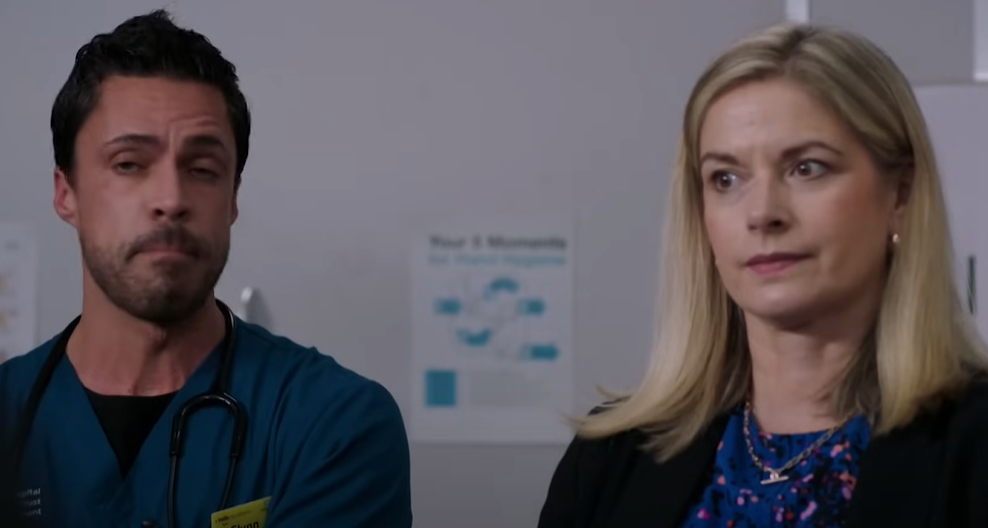
But Dr. Byron, despite his personal flaws, held firm. His conviction, forged in the crucible of Amaan’s humiliation, was unyielding. “I actually have a duty of care towards Nurse Amaan,” he stated, a line drawn in the sand between his professional obligations and his wife’s desperate pleas. Claire, seeing her husband’s resolve, escalated her tactics. In a chilling attempt at manipulation, she dangled a professional carrot, implying she had unfrozen his nursing budget. “Would that help?” she asked, her voice laced with a transactional desperation. It was a stark illustration of the deep-seated issues in their marriage, where even acts of support were reduced to bargaining chips.
The tension, already unbearable, finally snapped. Claire, no longer able to hold back, unleashed the truth that had been gnawing at her. “Like having an affair,” she spat, her voice laced with venom, cutting through his composure like a knife. The revelation hung heavy in the air, a seismic shockwave that instantly dwarfed the professional drama of the internal inquiry. Byron, caught off guard, stumbled to deny, to deflect, to defer the conversation to a more private setting. “I don’t want to do this here,” he pleaded, but Claire was beyond reason. Her raw pain erupted, refusing his touch, demanding answers. “When?!”
His confession was slow, agonizing. An affair during his “last tour” with a captain named Amber. Then the gut-wrenching admission that Amber was dead. Claire, momentarily stunned, pressed on, not out of morbid curiosity for a deceased rival, but to understand the depth of his detachment. Was he in mourning? “No,” he confirmed, cementing the cold, impersonal nature of the infidelity. “It didn’t mean anything. It was over,” he tried to rationalize, a pathetic attempt to minimize the profound hurt he had inflicted. But for Claire, it meant everything. “We could have been happy. After everything we’ve been through.” Her words were a lament for a future stolen, a past tainted.
Then came the final, crushing blow. “There were others.” The admission, delivered with a resigned sigh, ripped through the last vestiges of Claire’s composure. Her “Oh, you stupid, selfish fool” was not just an insult, but a cry of pure anguish, a testament to a marriage irrevocably shattered by years of secret betrayals. The weight of his cumulative deceit crashed down, revealing a chasm of dishonesty far deeper than she could have ever imagined.
In a moment of exquisite dramatic timing, as the full extent of Dr. Byron’s personal devastation unfolded, the harsh realities of the hospital environment reasserted themselves. Siobhan, a voice of immediate professional urgency, interrupted the scorched-earth confession: “Dr. Byron? So sorry to interrupt. We need you to take another look at Layla Croston.” Just like that, the intimate, agonizing fallout of his private life was abruptly shunted aside by the relentless demands of his public duty.

This episode of Casualty masterfully presented Dr. Byron as a complex, deeply flawed protagonist. He is a man who, despite his personal moral failings as a husband, demonstrates an unwavering commitment to professional ethics and the “duty of care” towards a vulnerable colleague. His resolute defense of Nurse Amaan, his willingness to stand up for the victim even if it risked his own professional standing or familial peace, paints him as a figure grappling with a profound internal conflict. Is his conviction born from genuine integrity, or is it a subconscious attempt to compensate for the moral vacuum in his personal life? The dramatic juxtaposition of his noble stance in the internal inquiry against the brutal honesty of his marital betrayal forces viewers to question the very nature of integrity.
The episode leaves audiences reeling, contemplating the wreckage of a marriage built on lies, and the precarious balance between a doctor’s professional oath and the messy reality of their human existence. Dr. Byron’s choice to prioritize his staff’s well-being over his family’s desperate pleas – at least in the short term – comes at an incalculable personal cost. The ER may be the battlefield for life and death, but for Dr. Byron, the true casualties of this episode were his own relationships, shattered beyond repair, leaving him to face a professional triumph amidst a personal wasteland. What kind of future awaits a man whose commitment to duty shines so brightly, even as his personal life lies in ruins? Casualty promises a compelling and painful journey to uncover the answer.