The acrid scent of dust and cordite hung heavy, a grim prelude to the chaos that would soon engulf a specialized military unit. In a scene that ripped straight from the harrowing realities of combat, BBC One’s medical drama Casualty recently plunged viewers into the heart of a high-stakes operation, where a single misstep threatened to unravel not only lives but careers. The episode, an intense masterclass in tension and human drama, culminated in a devastating explosion, leaving one soldier critically injured and another grappling with a perilous web of lies.
From the outset, the mission was fraught with peril. Deep within hostile territory, a unit faced the daunting task of breaching a booby-trapped door. The crackle of distant gunfire served as a relentless reminder of the stakes, amplifying the focused intensity of the soldiers, particularly the skilled breacher, Sergeant Erin Riley. Their objective: an Improvised Explosive Device (IED) wired directly to the door, a potentially massive blast waiting to detonate. Under immense pressure from their commanding officer, the unit moved with precision, each second ticking away like a fuse.
Sergeant Riley, with steady hands and nerves of steel, confirmed the IED’s presence, meticulously preparing the charge. Her expertise was undeniable, her composure a shield against the chaos that simmered around them. Corporal Chris Clark, her comrade, stood poised for action. “We go on the B of the bang,” he declared, a testament to the synchronized precision required in such operations. But even the most rigorous training can’t account for the unforeseen, the split-second misjudgment that shatters plans and lives.
In a horrifying turn of events that sent shockwaves through the unit, a flashbang – intended to disorient – detonated prematurely. In the deafening confusion, Chris, misinterpreting the concussive blast as the primary charge, surged forward, believing the path clear. It was a fatal error in judgment, one that would have cost him his life had it not been for Sergeant Riley’s extraordinary heroism. Without a moment’s hesitation, Erin, seeing the impending disaster, threw herself in front of Chris, shielding him from the full force of the real explosion. The ensuing blast was cataclysmic, a thunderous roar that swallowed the silence, leaving behind a scene of devastation and the agonizing cries of the wounded.
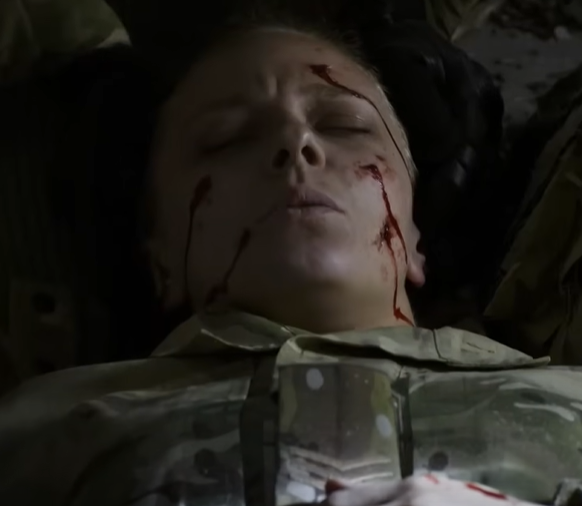
The immediate aftermath was a visceral portrait of trauma and urgent medical intervention. Paramedics Dix and Dominic scrambled to assess the casualties, their faces etched with grim determination. Sergeant Riley, the selfless hero, bore the brunt of the blast, her body wracked with horrific injuries. Wood shrapnel had torn through her, causing a severe pelvic injury and a brisk arterial bleed to her left thigh, an injury that could prove fatal in moments. Chris, though also injured, was alive thanks to Erin’s quick thinking. Yet, even amidst the life-and-death struggle, a different kind of battle began to unfold – one rooted in deceit and the complex dynamics of military culture.
Dominic, the demanding superior, wasted no time in his pursuit of answers, declaring, “Heads are going to roll.” But as the medical team fought to stabilize Erin, a disturbing narrative began to emerge, fueled by Chris’s desperate attempt to absolve himself. He vehemently accused Erin of gross negligence, claiming she had made a “stupid mistake” and was simply “not up to the job.” It was a shocking betrayal of the woman who had just saved his life, a calculated fabrication designed to protect his own career at the expense of hers.
Meanwhile, Dr. Knight, tasked with treating Chris, found himself navigating not just a medical emergency but a tangled web of accusations. Chris, clinging to his fabricated story, spun a tale of Erin’s incompetence, even while suffering from severe respiratory distress, a direct consequence of the blast. The young soldier was fighting for his breath, literally and figuratively.
The pressure mounted on Sergeant Riley. Despite her critical condition and the profound injustice of Chris’s lies, she found herself in an impossible position. In a chilling moment of candor, Erin revealed the systemic challenges faced by women in combat roles. “It’s been hard enough getting women in combat roles as it is,” she confided, hinting at the deep-seated prejudices she navigated daily. To “make a fuss” or be “labelled a grass” by outing Chris, even to clear her own name, would risk not only her career but potentially jeopardize the fragile progress made by other women seeking to serve on the front lines. So, with a heavy heart and a quiet sense of sacrifice, Erin initially corroborated Chris’s false account, effectively sacrificing her reputation to protect him and, by extension, the precarious acceptance of women in combat.
As Sergeant Riley was rushed into surgery, her fate hanging precariously in the balance, the empathetic Dr. Rita, who had been treating Erin, confronted Chris. She knew, instinctively, that something was amiss. “She risked her life trying to save you. Don’t you think you owe it to her to tell the truth?” Rita’s plea was a desperate attempt to appeal to Chris’s conscience, to break through his self-serving narrative.
In the high-dependency cubicle, Chris’s condition rapidly deteriorated. His sats plummeted, and his respiratory distress worsened, forcing Dr. Knight to perform an urgent chest drain. The scene was fraught with tension, as Dr. Knight, initially exuding an air of almost arrogant confidence (“I’ve done this procedure a dozen times when I was in Miami”), demonstrated undeniable skill under pressure, stabilizing Chris. Yet, the emotional burden of his lie, coupled with his near-death experience, began to chip away at his resolve. In a moment of acute vulnerability, believing he wouldn’t survive, Chris whispered a profound plea to Rita: “Tell her… Tell her I’m sorry, will you? Please. Give them to my OC, he’ll understand.” Though the nature of the “them” remained unspoken, it was a clear signal of his remorse, a desperate attempt to right a grave wrong from the precipice of death.
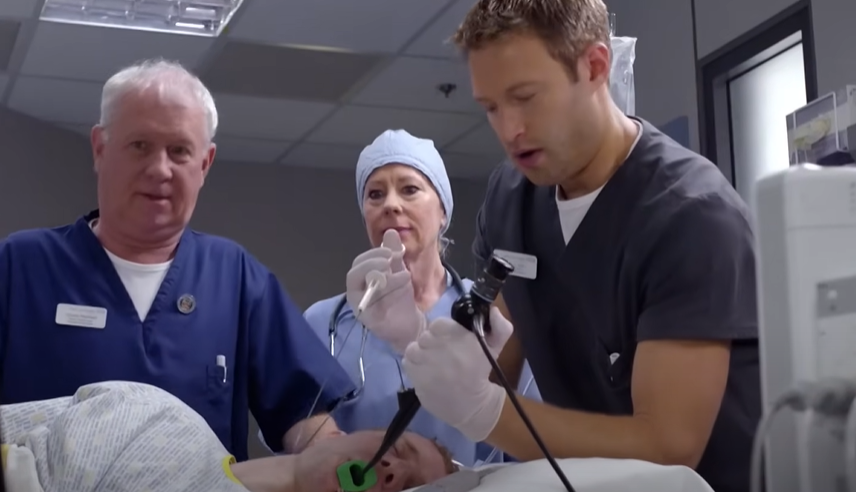
The dramatic climax arrived as Dr. Knight, performing a bronchoscope, discovered the shocking truth behind Chris’s respiratory issues: his own missing tooth lodged in his lung. This gruesome finding, a direct consequence of the blast he had caused, served as a potent, visceral reminder of the incident. It was a physical manifestation of his guilt, a constant, painful reminder of the lie he was living.
With Chris stabilized and the truth of his internal injury revealed, the external truth could no longer be contained. Dr. Knight, seeing the injustice unfolding, subtly challenged Dominic’s unwavering belief in Chris’s story. “People don’t always tell their bosses the truth,” he remarked, hinting at the deeper currents beneath the surface. He went further, suggesting Dominic was “blaming the wrong person,” emphasizing that Erin’s career was “at stake.”
The weight of his actions, coupled with the realization that Erin was fighting for her life and career because of his lie, finally broke Chris. Confronted by Rita, and likely by his own near-fatal brush with death, he chose redemption. In a poignant scene of raw honesty, Chris confessed to his superior: “It was me who thought the flashbang was the breach and went early… And the fact that you dived in front of me. You saved my life.”
The emotional reunion between Chris and Erin, once bitter accuser and accused, was a testament to the human capacity for forgiveness and the enduring bonds forged in the crucible of combat. Lying in her hospital bed, still recovering, Erin’s sharp wit returned, teasing Chris for his “idiotic” actions but acknowledging his bravery in finally speaking the truth. “You’re a good soldier, Sergeant Riley,” Chris admitted, his voice thick with genuine respect and remorse. “We’re lucky to have you in the squad.”
This powerful Casualty episode transcended mere medical drama, delving deep into themes of sacrifice, integrity, and the often-unseen struggles faced by soldiers, particularly women striving to prove their worth in male-dominated environments. It was a stark reminder that the battle for truth can sometimes be as harrowing, and as vital, as any faced on the battlefield. Sergeant Riley’s heroism, initially overshadowed by a lie, ultimately shone through, cementing her place not just as a survivor, but as a true testament to courage, both physical and moral, in the face of overwhelming odds. The episode left viewers reflecting on the profound impact of split-second decisions and the enduring power of honesty, even when faced with the gravest of consequences.