A quiet family dinner erupts into a horrifying tragedy, tearing a family business – and its owners – apart at the seams. Deep-seated resentments, simmering for years, boil over into a dramatic confrontation just moments before a catastrophic incident leaves one daughter fighting for her life and the other grappling with guilt and injury.
In what began as a seemingly ordinary evening at the beloved family establishment, “Zeds,” a culinary sanctuary known for its classic Italian fare, a domestic dispute escalated with unimaginable consequences. The Panzini family, custodians of the restaurant’s legacy, found their personal and professional lives collide in a moment of pure, unadulterated chaos that viewers of BBC’s long-running medical drama, Casualty, are still reeling from.
The episode opened innocently enough, with the aroma of freshly prepared pasta hinting at culinary delights. Yet, beneath the surface of domestic bliss, a tempest was brewing. Lisa, the biological daughter, a sharp and ambitious young woman, was attempting to introduce a new, modern twist to the menu – a pasta dish she believed was innovative. Her efforts, however, were met with immediate resistance from her father, Mr. Panzini, a man steeped in tradition and fiercely protective of his late wife’s legacy.
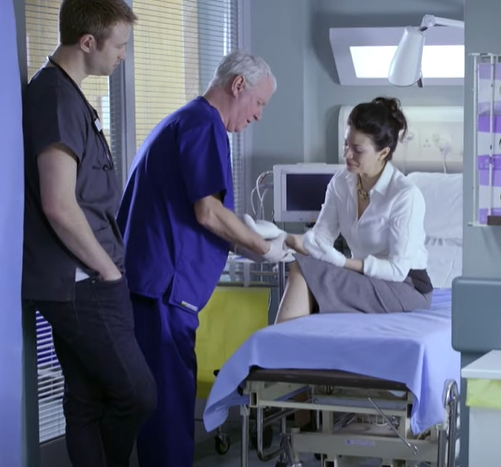
“Oh, that’s superb,” Mr. Panzini declared, his tone laced with a paternal pride that quickly soured. “Thought you’d like it.” But the compliment was not for Lisa. It was directed at his adopted daughter, Zed, the restaurant’s current resident chef, who sat quietly observing the unfolding tension. Lisa’s immediate and curt rejection – “I’m fine” – was a harbinger of the storm to come.
The father’s insistence that “There won’t be another restaurant in a 100 miles that does a pasta dish like that” was met with Lisa’s biting retort: “Maybe there’s a reason for that.” This seemingly innocuous exchange quickly spiraled, revealing the raw nerves of a family business in flux. Lisa passionately argued for modernization, highlighting the aging clientele and the need to adapt. “These restaurant chains don’t just throw together their menus. They work from a marketing strategy,” she pressed, advocating for a future-forward approach. “They don’t do a pasta dish like that because they can’t. I’m just trying to think of the future. Our regular clientele are getting older with every year.”
Her father, visibly frustrated, retorted, “You make it sound as if we’re about to go bust.” He clung to the past, reminding her of their steady covers, seemingly oblivious to Lisa’s deeper concerns. Lisa’s frustration boiled over, drawing a painful comparison to her deceased mother, “5 years ago, before mom died, we were doing 40 to 50 at lunch. She was a great chef. People loved her food.” The implication was clear: Zed, despite her talents, wasn’t quite measuring up to the formidable shadow cast by the beloved matriarch.
The tension escalated when Mr. Panzini questioned the originality of Zed’s ‘new’ recipe, only for Zed to admit, “It’s one of mine’s.” Lisa seized on this, twisting the knife further: “So it’s not new. It’s old.” The father’s protective instincts flared: “I don’t know what your problem is, but you should be backing your sister, not putting her down.”
This was the breaking point for Lisa. Years of feeling sidelined and overlooked erupted. “I don’t know what I have to do to impress you,” she cried, a raw wound exposed. Her father’s seemingly benign response, “You don’t have to do anything. You’re my daughter,” only fueled her pain. “Maybe you’ll think more of me if I wasn’t,” she retorted, hinting at the adopted Zed’s arrival as the catalyst for her feelings of inadequacy.
In a moment of cruel transparency, Lisa articulated the core of her pain, suggesting that Zed, due to her troubled past, received more attention. “You know what S [presumably Zed, or ‘she’] was like when she first came to us. That had nothing to do with me. She needed serious care and detention. I was 16. And what I didn’t need was to be ignored.” Her father’s denial – “Nobody ignored you” – was met with the heartbreaking accusation: “You’re ignoring me now.”
The argument reached its crescendo. Lisa, feeling utterly disenfranchised, lashed out at her father’s traditionalism: “What? Because I don’t want my restaurant turned into a design concept with no heart.” Lisa, stung, twisted his words: “And that about sums it up. You think I’m heartless? … Not in so many words. Okay. I don’t cook. I don’t drool over photographs of Bologna. But I’m still your biological daughter.” Her father’s strained “I know that” was cold comfort. “Then it would be nice if just for once you acted as if I was,” Lisa pleaded, her voice laced with despair. “It’s obvious I don’t really fit in. So I’ve decided to quit the restaurant.”
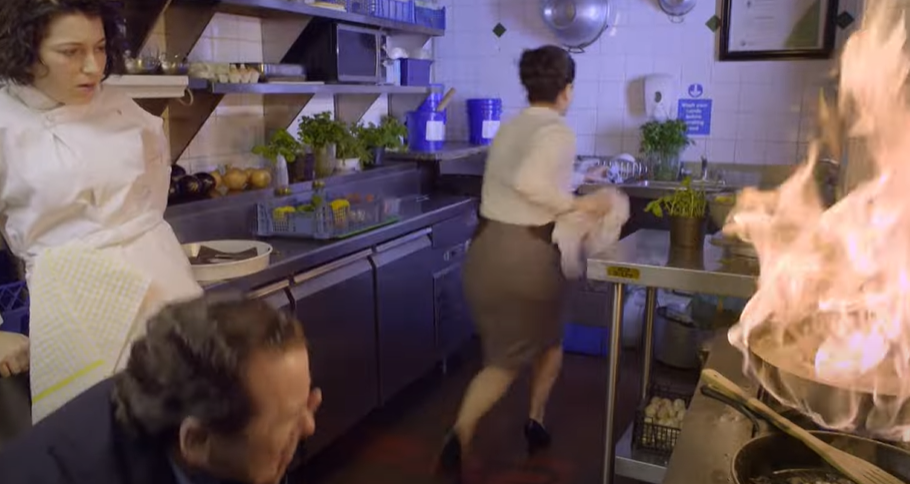
The words hung in the air, a declaration of severing ties, when suddenly, the screen plunged into chaos. A violent tremor, a sickening crash – the restaurant, perhaps a poorly secured fixture or shelving unit, gave way. “Oh Jesus. You okay?” Mr. Panzini cried, his paternal instincts overriding their bitter exchange. But it was not okay. A life-threatening incident had occurred.
In the harrowing moments that followed, the true extent of the tragedy became agonizingly clear. Lisa, though conscious, was visibly injured, her hands and face bearing the brunt of the impact. “Stay still. Stay still.” But it was Zed who had suffered the most grievous injury. The immediate scene showed emergency services scrambling, the medical team at Holby City Hospital quickly taking over. “Your daughter’s in a critical condition, but she’s in very good hands,” a doctor assured a distraught Mr. Panzini, as Zed was rushed to theatre for an emergency “thoracic” procedure – a clear indication of severe chest trauma. The stakes were life and death.
As the frantic pace of the emergency room continued, the emotional drama of the Panzini family was laid bare. Lisa, bandaged and bruised, found herself alone, feeling utterly abandoned. Her father was with Zed, an understandable decision given the severity of Zed’s condition, but for Lisa, it was another painful confirmation of perceived favoritism. “You know, since you’ve been here, you haven’t even asked how she is,” a compassionate nurse, Charlie, observed, perhaps hoping to nudge Lisa towards empathy.
Lisa, her voice laced with a mixture of fear and resentment, finally asked, “Is she all right?” Charlie’s grave response – “My colleagues had to perform an emergency procedure on her. They’re taking her to a theater now. That sounds bad… Well, she survived. Are you saying there was a chance she might not have? Yeah, a very serious chance. It could still go either way.” – painted a stark picture of Zed’s fight for survival.
Still, Lisa’s focus remained on her own pain and abandonment. “Did you see my dad?” she asked. Charlie confirmed, “Yeah, I told him I was treating you.” Lisa’s cutting observation, “But he didn’t ask,” spoke volumes. “He’d still rather stay with her than see how I am,” she muttered, the jealousy festering even in the face of near-tragedy.
The true climax of their familial discord occurred at Lisa’s bedside. When her father finally came to her, it was not with comfort, but with a renewed wave of anger and pain. “As soon as your favorite daughter is okay, you have time for me,” Lisa lashed out, her voice dripping with bitterness. Mr. Panzini, overwhelmed by stress and fear for Zed’s life, snapped back, “Zed is seriously ill. This hasn’t been fun. If it weren’t for you, none of this would ever have happened.”
Lisa, in turn, unleashed years of pent-up anger: “Well, if you and mom hadn’t adopted some kid, then you might have remembered who your real daughter…” But before she could finish, her father delivered a devastating blow. “Shant has been more of a daughter than you ever have.” The words hung heavy, unforgivable. “Now you’ve said it,” Lisa whispered, “Said what you’ve been wanting to say for years. She’s the top of the tree and I don’t get a look in.” In a fit of rage, Mr. Panzini made a definitive, and potentially irreversible, declaration: “Then fine. If that’s how you think, I accept your resignation. Come and collect your things from the restaurant. I don’t want to see you there ever again.”
“You’re not serious,” Lisa gasped, her voice trembling. “Yes, I am. Because of your petty jealousy Zed nearly got today. That’s not going to happen again. I promise you.” The silence that followed was deafening, the chasm between them seemingly irreparable.
Later, a compassionate medical professional intervened, offering Mr. Panzini a much-needed perspective. “The man was upset. People say things they don’t mean when they’re upset,” Charlie remarked, acknowledging the father’s pain. But Lisa, still reeling, insisted, “He meant it. I know my dad. We were fine until they adopted Zed. Everything suddenly changed when she came on the scene. They felt sorry for her. Never gave me a chance. I think I was the favorite. Well, certainly my mom was anyway.” The nurse gently reminded Mr. Panzini, “Look, this has been a tough day for you. And it’s also been a tough day for Lisa. Look, I don’t have family, no kids that I know of, but I do know siblings. Sometimes a brother and sister can’t live together, but they can’t live apart either. Do you know what I mean?”
The words resonated. Mr. Panzini, seeing the depth of his harshness, confessed, “I said that because I was hurting. Lisa’s my daughter. I love her.” In a poignant turn of events, the father, humbled by the near-loss of both his daughters, requested to see Lisa.
The reunion was raw, tearful, and cathartic. “I’m sorry, Dad,” Lisa choked out, her voice thick with emotion. “I’m really sorry.” Mr. Panzini, embracing her, responded with paternal comfort, “I know. We’re going to be fine. I couldn’t bear to lose you or my sister. We’ll sort it out. I promise.”
The episode concluded with Lisa at Zed’s bedside, her earlier resentment replaced by a profound love and concern. Speaking to her unconscious sister, Lisa’s voice cracked with vulnerability: “I hope you can hear me. Oh, you better get better. ‘Cuz the truth is I’m a lousy cook.” It was a moment of levity amidst the profound pain, a quiet promise of a future where sisters, despite their differences, would find their way back to each other.
This Casualty episode was a masterful exploration of the fragile bonds of family, showcasing how long-buried resentments, when pushed to their limit, can have devastating consequences. The freak accident at Zeds restaurant wasn’t just a physical catastrophe; it was an emotional reckoning, forcing the Panzinis to confront their deepest insecurities and, perhaps, find a path towards healing and genuine reconciliation. The future of Zeds, and the Panzini family, hangs precariously in the balance, reminding us that even in the face of unimaginable tragedy, hope for healing can emerge from the wreckage.