In a truly harrowing and emotionally charged episode that has left viewers reeling, “Casualty” plunged its protagonist, Stevie Nash, into a terrifying vortex of domestic terror and family secrets, orchestrated by the grieving son of her deceased lover. Titled “Internal Affairs,” the installment peeled back layers of past pain and blame, revealing the devastating consequences of unresolved grief and a shocking campaign of harassment that escalated to a full-blown police raid on Stevie’s home. The episode masterfully interwove psychological suspense with the raw, visceral drama “Casualty” is renowned for, leaving audiences on the edge of their seats and deeply invested in Stevie’s perilous plight.
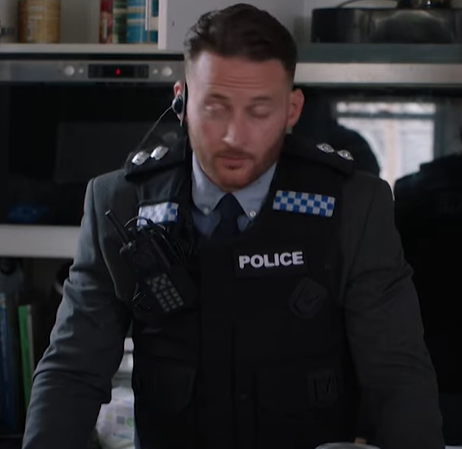
The nightmare began with a brutal and unexpected invasion of privacy. What started as a seemingly normal evening for Stevie quickly spiraled into a scene of utter chaos as uniformed officers stormed her flat. Their urgent, authoritative commands—“Show me your hand. Drop what you’re holding, please. Is there anybody else here?”—echoed through the confines of her sanctuary, instantly shattering any sense of security. The accusation was grave: “reasonable grounds to believe that illegal substances are being manufactured in this property,” coupled with “an imminent threat to life.” For Stevie, a respected paramedic, the humiliation and shock were palpable. As her home was meticulously searched, her personal space violated, she was forced to endure the indignity of a body search, her arms outstretched, a symbol of her helplessness in the face of this bewildering assault.
Amidst the disarray, Stevie’s mind raced, connecting the dots of a disturbing pattern that had been steadily escalating. “Someone is doing this to get at me,” she insisted to the officers, her voice laced with a desperate urgency. She recounted a string of alarming incidents: her flat broken into, her car deliberately damaged, and the perpetrator brazenly showing up at her workplace. Yet, in a testament to her resilient, perhaps even stubborn, nature, she admitted to not having officially reported these prior acts of harassment, save for the car damage. The officers, finding no evidence to substantiate the fabricated claims against her, eventually called off their intrusive search. “We found no evidence to substantiate the accusation against you and no further action will be taken,” they declared, offering a hollow victory to Stevie. While relief washed over her, it was fleeting, quickly replaced by a simmering rage as she confronted the injustice: “You come in here all ‘here’s Johnny,’ you trashed my flat and now it’s like, ‘let’s clear out!'” The officers’ only “advice” was to report the harassment, a cold comfort for a woman whose life had just been turned upside down.

The true architect of Stevie’s torment, however, soon emerged from the shadows, making the ordeal intensely personal. Just as Stevie was grappling with the aftermath of the police raid, a familiar, unwelcome figure appeared at her doorstep: Ben, the son of her deceased lover, Rich. The confrontation was immediate and explosive. “It is you. What the hell are you doing here, Ben? Get out of my way!” Stevie’s demand was met with Ben’s chilling refusal, “No. This is my home.” The audacity of his claim, coupled with his presence in the very space he had conspired to violate, solidified the depth of his malicious intent.
Ben’s torment was not merely an act of random cruelty; it was a calculated campaign fueled by a profound, toxic cocktail of grief, blame, and a desperate desire for others to share his suffering. As the argument escalated, Stevie invoked his father, “Seriously, what would your dad say if he could see you?” a desperate attempt to appeal to any lingering sense of morality. But Ben’s response was sharp and defensive, “Don’t talk. You don’t talk about my dad.” The mention of Rich, the man who was once at the center of both their lives, ignited a raw wound within Ben. He quickly retaliated, dragging his own mother, Siobhan, into the painful dialogue. “Fine. Let’s talk about your mom then. How would she feel if she found out what her son was doing? Should we call her, shall we?” Stevie threatened, attempting to use the same emotional leverage against him.
It was in this harrowing exchange that Ben’s twisted motivation came to light. He confessed to engineering the police raid, driven by a desire for vengeance. “If we’re all suffering, so should you,” he declared, his words dripping with a chilling conviction. He believed Stevie was responsible for the unhappiness in his parents’ relationship before Rich’s death, accusing her: “It’s not my fault he died, Ben. No, but it is your fault that things weren’t good between them when he did. Now it’s all ruined. She can’t just miss him. She can’t just grieve.” This heartbreaking revelation underscored the depth of Ben’s psychological turmoil. Consumed by grief and a misguided sense of loyalty, he had targeted Stevie as the embodiment of his family’s fractured past, projecting his own pain and inability to cope onto her. His actions were a distorted cry for justice, a desperate attempt to equalize the burden of sorrow he felt overwhelmed by.
The escalating confrontation was abruptly cut short by the frantic arrival of Ben’s mother, Siobhan. Her presence instantly shifted the dynamics, adding another layer of complex family drama. Siobhan, visibly distraught and struggling to keep herself composed, was torn between protecting her troubled son and confronting his heinous actions. “Mom, don’t mom me,” Ben snapped, resisting her desperate attempts to control him. Stevie, meanwhile, demanded accountability: “Deal with it. How? That’s none of your business. Are you kidding me? None of my business. How do I know it’s not going to happen again?” Her frustration was palpable, her need for reassurance and an apology overwhelming.
Siobhan’s response, however, was far from the unqualified support Stevie expected. While acknowledging Ben’s “totally unacceptable” behavior and promising to “speak to him,” Siobhan quickly turned the tables, admonishing Stevie for seeking “sympathy.” The implication was clear: Siobhan believed Stevie, despite being the victim of harassment, shared some blame for the family’s turmoil, particularly concerning Rich. “And whose fault is that, I wonder? Oh, I don’t know. Uh, maybe Rich’s,” she bitterly retorted, hinting at deeper, unresolved issues between herself, Rich, and potentially Stevie. This moment underscored the tangled web of relationships and the lingering resentments that permeated Rich’s death. The two women, both grieving Rich in their own ways, found themselves at odds, unable to fully unite against Ben’s destructive actions due to their own complicated history.
The episode culminated in a poignant, yet still unsettling, moment of fragile truce. Stevie, despite having every reason to press charges, opted against involving the police, a decision perhaps influenced by Siobhan’s desperate plea and a glimmer of understanding for Ben’s raw pain. Siobhan, then, turned her attention fully to her son, attempting to soothe his tormented soul and preserve the cherished memory of his father. “The life that we had, our home, you, your brother, your sister… I wouldn’t change any of that. None of it. Not for one millisecond,” she reassured Ben, her voice choked with emotion. She implored him not to let the complex reality of her relationship with Rich diminish his own love and memory of his father. “He was a good dad, and he loved the bones of you. He did,” she insisted, trying to rebuild the foundation of trust and love that Ben’s grief had shattered. Ben’s tearful confession, “I just miss him so much,” was a stark reminder of the raw, unadulterated pain at the heart of his destructive actions.
The “Casualty” episode “Internal Affairs” was a masterclass in psychological drama, dissecting the corrosive effects of grief, blame, and the desperate search for answers in the wake of loss. It left Stevie Nash in a precarious emotional state, her home violated, her safety compromised, and her relationships with Ben and Siobhan fractured. While a semblance of understanding was achieved, the underlying tensions and deep-seated resentments surrounding Rich’s death remain dangerously unresolved. The question now looms large: Can this fragile family truly heal, or will Ben’s tormented spirit continue to haunt Stevie, forever linking their lives through the shadow of the man they both loved and lost? Viewers are left to ponder the long-term emotional scars and the very real possibility of Ben’s unaddressed issues resurfacing, promising more gripping drama to come in the intense world of “Casualty.”