The hallowed halls of Holby City Hospital, usually a backdrop for life-saving miracles and medical emergencies, were recently transformed into a crucible of truth and reckoning. In an episode that viewers are still reeling from, the long-standing medical drama “Casualty” delivered a storyline of searing intensity, culminating in the dramatic downfall of seemingly esteemed consultant surgeon, Russell Whitelaw. What began as a celebratory farewell spiraled into a chilling exposé of abuse, systemic cover-ups, and the ultimate triumph of collective bravery. This wasn’t just another medical drama; it was a potent commentary on power, victimhood, and the fight for justice in the workplace.
The scene was set for a poignant departure. Russell Whitelaw, a figure of authority and, to many, respect within the hospital, was being honored with a leaving party. His colleagues, oblivious to the festering darkness beneath his polished facade, clapped politely, celebrating his supposed next chapter: a teaching position at a theatre remarkably named in his honour. The atmosphere was one of quiet reverence, a final tribute to a man who, on the surface, had contributed significantly to Holby’s medical landscape. Yet, this façade of respectability was about to be shattered in the most public and humiliating fashion imaginable.
The first crack in Russell’s carefully constructed image came with the arrival of Nurse Amaan, better known as Rida. Her entrance wasn’t a quiet farewell; it was a storm. With righteous fury in her eyes, Rida tore into the polite proceedings, her voice cutting through the celebratory chatter like a scalpel. “He’s not leaving by choice, everyone,” she declared, her words dripping with a contempt born of deep personal pain. “He’s leaving because he’s a predator and a bully, and the trust is covering it up.”
The immediate reaction was a stunned silence, followed by murmurs of disbelief. Russell, ever the master manipulator, attempted to dismiss her as “delusional,” a desperate bid to maintain control and delegitimize her accusations. But Rida, fortified by years of silenced suffering, would not be swayed. She laid bare her personal trauma, accusing him directly: “You sexually assaulted me. Remember? You groomed me. You got in my head, made me feel like… I wasn’t good at my job.”
This wasn’t just a recounting of a physical violation; it was an articulation of the insidious psychological warfare waged by a predator. Russell’s grooming tactics – undermining Rida’s professional confidence, isolating her, making her question her own abilities – were revealed as part of a calculated strategy to exert control and perpetuate his abuse. It laid bare the emotional and mental scars left by his actions, far beyond any physical touch.
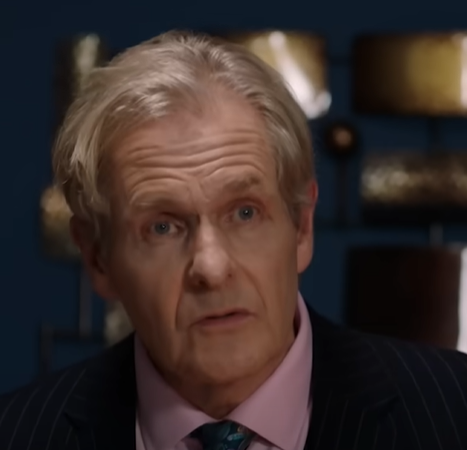
The dramatic crescendo came when Rida, with breathtaking courage, turned to the room, challenging the silent complicity that had allowed Whitelaw to thrive. “Really, Russell? Because I know there’s other people in this room… who’ve been sexually assaulted, too.” Her voice, trembling but resolute, cut through the tension. “Who else has been assaulted by Russell? A touch on the bum. Rubbed up against. Backed into a corner. Come on! You’re all so quiet!”
The silence that followed was deafening, a testament to the pervasive fear Russell had instilled. Yet, Rida pressed on, broadening her accusation beyond sexual assault to encompass the wider pattern of abuse. “OK, who’s been bullied, then? Made to feel worthless. Made to feel this little.” This shift in focus tapped into a broader vein of shared trauma, acknowledging that Whitelaw’s reign was not just about sexual misconduct but also a pervasive culture of intimidation and demeaning behavior. The implication was clear: Russell’s victims were not singular isolated incidents, but part of a pattern, a “reign of terror” as Rida rightly called it.
While his colleagues wrestled with the uncomfortable truths, the most poignant and devastating blow came from an unexpected quarter: Russell’s own daughter, Claire. Overhearing the accusations, Claire’s initial disbelief quickly crumbled under the weight of Rida’s unwavering conviction. Her father, her hero, was being exposed as a monstrous figure, a predator who had inflicted deep pain upon others. The realization was excruciatingly painful, shattering the idealized image she had held her entire life. Confronting him, she articulated the betrayal felt by countless family members of abusers: “This is not some employment tribunal, Dad. I am your daughter. I don’t want you seeing the girls at the moment… You were my hero, Dad. And you’ve ruined it.” Claire’s decision to cut off access to his grandchildren was a raw, visceral consequence, bringing the professional devastation into the most personal of realms. It underscored the multi-faceted impact of abuse, extending its corrosive reach far beyond the immediate victims.
The episode also shed light on the systemic failures that allowed Whitelaw’s actions to persist. Rida had previously signed a Non-Disclosure Agreement (NDA), implying that the hospital trust, in an attempt to protect its reputation or avoid scandal, had effectively silenced her. This “Internal Affairs” aspect of the narrative highlighted the uncomfortable truth that institutions often prioritize damage control over victim welfare, managing out problematic individuals rather than holding them accountable. Rida’s job security had been leveraged against her principles, forcing her into a painful silence.
However, the tide truly turned with the revelation of the “whispering list.” This anonymous online forum, a digital repository of shared experiences, became the ultimate weapon against Russell’s deceit. Rida’s supportive colleague, Cam, presented her with damning evidence: a litany of anonymous posts mirroring Rida’s own experiences. “Russell Whitelaw cornered me into his office, on my first day of surgery rotation.” “I almost quit nursing because of someone like Whitelaw. Too scared to make a complaint.” These posts, a collective cry for justice from previously silenced voices, provided irrefutable proof of Russell’s long-standing pattern of abuse. The “whispering list” served as a powerful metaphor for the MeToo movement, demonstrating how the collective power of shared testimony, even anonymous, can break down barriers of fear and bring about accountability where traditional channels have failed.
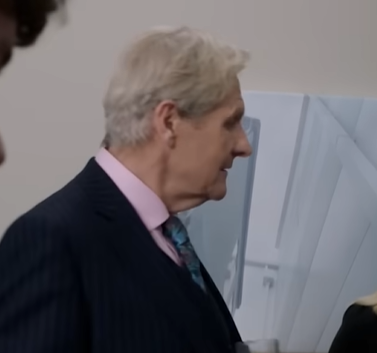
The impact was immediate and undeniable. Confronted with the digital evidence, Russell’s carefully constructed facade finally collapsed. His new employer, once eager to bring him on board, rescinded their offer of employment. The online “gossip,” as Russell dismissively called it, was in fact the truth, amplified and undeniable. “You’ve done it. You’ve won,” he admitted to Rida, his voice defeated, his carefully planned escape route irrevocably blocked.
The resolution, though simple, was deeply satisfying. As Rida and Cam shared a celebratory pizza, a symbol of a hard-won victory and a return to some semblance of normalcy, viewers were left with a powerful message. Justice, while sometimes slow and arduous, can prevail. The episode underscored that the courage of one individual to speak out can inspire others, dismantle systems of silence, and ultimately bring a predator to account. “Casualty” didn’t just tell a story; it resonated with the real-world struggles of victims and the importance of collective action in confronting power and abuse. Russell Whitelaw, for all his cunning and manipulation, nearly got away with it. But thanks to the bravery of Rida Amaan and the amplifying power of a shared truth, his reign of terror at Holby City Hospital finally came to an end.