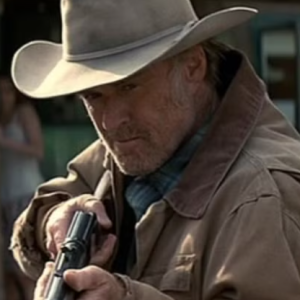
In the unforgiving landscape of Montana, where the powerful Dutton family clings to their sprawling ranch with a tenacity forged in blood and legacy, the line between justice and survival often blurs. No character embodies this precarious balance more acutely than Jamie Dutton, the Harvard-educated lawyer whose intellect is as sharp as his family loyalties are perpetually tested. A pivotal scene, succinctly titled “Jamie Lays Down the Law” by Paramount Network, offers a chillingly precise illustration of how the Duttons, even without raising a fist, exert their dominion over those foolish enough to challenge them. This isn’t just a legal skirmish; it’s a cold, calculated chess match played in the sterile confines of a state prosecutor’s office, with Jamie as the unflinching grandmaster.
The scene opens not with a gunfight or a ranch-hand brawl, but with the quiet hum of fluorescent lights and the crisp rustle of legal papers – a setting that, for the Duttons, can be just as deadly as any open range. A woman, whose aggrieved demeanor speaks volumes, sits opposite Jamie. Her intent is clear: to press charges against Beth Dutton, the family’s notoriously volatile financial titan, for an alleged bar fight. For many, Beth’s fiery temperament and penchant for explosive confrontations are legendary, and one might easily assume a clear-cut case of assault. But Jamie Dutton, ever the strategist, sees a different picture – a narrative he is determined to re-write, not through brute force, but through the weaponized precision of the law.
Jamie’s initial approach is deceptively calm, almost disarmingly polite. He acknowledges the woman’s desire to press charges, but immediately introduces the first note of discord: “I feel I must point out that by doing so, you are exposing yourself to prosecution.” This isn’t a threat; it’s a statement of undeniable legal fact, delivered with the weight of his office. The woman, clearly taken aback, questions how. And thus, Jamie begins his surgical dissection of her claim, revealing the intricate web of legal technicalities and damning details that will ultimately trap her in her own pursuit of justice.
The crux of Jamie’s argument rests on two foundational legal principles: the absence of a self-defense claim in a bar fight, particularly one instigated by the accuser, and the broad definition of assault. He meticulously reconstructs the incident, citing details that only a thorough police report or meticulous investigation could uncover. “I assume you had been drinking,” he posits, a seemingly innocuous observation that immediately casts doubt on her sobriety and judgment. Then comes the pivotal revelation: “I understand you approached Miss Dutton and instigated the incident.” The woman vehemently denies this, but Jamie, with the unwavering calm of a man holding all the cards, quotes her verbatim: “‘I’m taking your husband home. You can come with us and watch or he can tell you about it tomorrow.'”
This line, delivered with icy precision, immediately frames the bar altercation not as a spontaneous act of violence by Beth, but as a reaction to a clear provocation. The target of the woman’s misguided affection, though unnamed, is undeniably Rip Wheeler, Beth’s fiercely loyal, equally volatile partner. The implication is staggering: the woman didn’t just annoy Beth; she threatened the sanctity of Beth’s most primal possession – her man. To the Duttons, particularly Beth, this is an unforgivable trespass, an act of war. Jamie’s recitation transforms Beth’s alleged “assault” into a response to a clearly hostile, humiliating taunt, strategically shifting the narrative from victim to instigator.
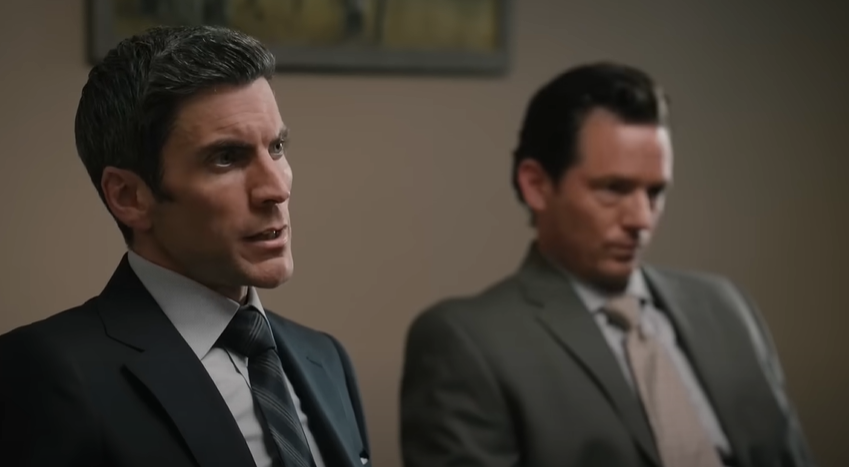
Jamie then elaborates on the legal definition of assault, explaining that physical contact isn’t necessary for the charge to stick. “Making statements or actions that threaten harm to another or make them feel they’re in danger is assault. You don’t have to hit someone to commit assault. You just have to present a threat. You presented the threat.” This is a masterstroke. By quoting the woman’s words and explaining their legal implication, Jamie flips the script entirely. The aggressor, in the eyes of the law as Jamie presents it, is no longer Beth Dutton, but the woman herself.
But Jamie isn’t done. He then introduces the final, devastating blow: the implications for the accuser’s own freedom. “So if you press charges, the state must press charges against you, and since you’re not a resident of Montana, you present a Flight Risk, and your bail will be withheld.” The impact of this statement is palpable. Her brief stint in a Montana jail, awaiting trial with no guarantee of bail, would be a nightmare. Far from achieving justice, she would find herself ensnared in a legal quagmire, stripped of her freedom in a foreign state, all for a bar fight she instigated. This is the chilling reality of crossing the Duttons: their reach extends far beyond the ranch fence, into the very fabric of the legal system they so often manipulate.
The woman’s frustration boils over, her indignant “So she just… she just gets away with it?” a desperate plea against the cold logic Jamie has deployed. But Jamie, ever the pragmatist, clarifies Beth’s fate: “She didn’t get away with anything. She spent the night in jail. She’s going to be charged with disorderly conduct.” This minor charge, a mere slap on the wrist for Beth, stands in stark contrast to the potential life-altering legal entanglements facing the accuser. The choice, as Jamie calmly states, is hers. It’s a choice between a symbolic victory for Beth (a night in jail) and a potentially ruinous defeat for the woman herself.
The woman’s bitter resignation, her desperate wish to “get out of this state,” and her final, frustrated epithet – “Fcking hillbillies!” – underscore her complete capitulation. Jamie’s deadpan “Well, the feeling is mutual” is a rare moment of personal, almost vindictive, satisfaction from the perpetually tormented lawyer. His final, polite dismissal, “May I leave? Please. Save me a ton of paperwork,” is the ultimate mic drop, sealing his victory and reinforcing his cold, calculated efficiency.
This scene is a microcosm of Yellowstone’s core themes. It highlights Jamie’s tragic brilliance – his legal mind is undeniably formidable, a potent weapon for the family he simultaneously despises and desperately seeks to impress. His loyalty, though often conflicted, ultimately bends towards protecting the Dutton empire, even if it means leveraging the law in ethically dubious ways. It also reaffirms Beth’s untouchable status, showcasing how the family’s influence ensures that even her most outrageous behaviors often result in minimal repercussions.

Moreover, the scene underscores the vast power differential between the Duttons and outsiders. For John Dutton and his children, Montana isn’t just a place; it’s their kingdom, and they are its unelected sovereigns. Those who enter their realm, especially those who challenge their authority or their loved ones, quickly learn the consequences. The accuser, a non-resident, is swiftly reminded of her vulnerability and lack of roots in a state where the Duttons are the roots.
“Jamie Lays Down the Law” isn’t merely a legal procedural clip; it’s a dramatic demonstration of strategic warfare, fought not with bullets but with precedents and carefully chosen words. It solidifies Jamie Dutton’s role as the family’s indispensable, albeit reluctant, legal protector, and reminds viewers that in the world of Yellowstone, the law is not always an impartial arbiter, but a tool in the hands of those powerful enough to wield it. It’s a chilling reminder that in Montana, sometimes, the best defense is a devastating offense, orchestrated by the one Dutton who truly understands how to exploit the system.