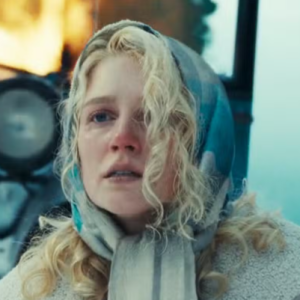
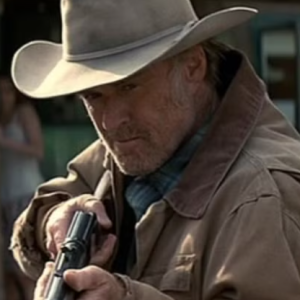
In the vast, untamed expanse of the American West, where history is etched into every mountain range and whispered on every prairie wind, Taylor Sheridan’s “1923” continues its relentless exploration of the Dutton family’s arduous journey. Amidst the sweeping vistas and brutal struggles for survival that define this gripping prequel to “Yellowstone,” it is often in the quiet, intimate moments that the series delivers its most profound punches. One such indelible scene, titled “Spencer’s Trade,” transcends a simple bartering of objects, morphing into a poignant meditation on truth, legacy, and the indelible imprint of the past on the present.
As the locomotive thunders across the Montana landscape, a symbol of industrial progress cutting through timeless wilderness, the audience is reunited with Spencer Dutton, a character whose very essence embodies the harrowing scars of the Great War and the dangerous allure of the African wild. Having sought solace in hunting and isolation, Spencer’s reluctant return journey to the Yellowstone ranch is fraught with a unique blend of trepidation and burgeoning hope. His hardened exterior, honed by years of conflict and peril, is momentarily softened by an unexpected encounter aboard the train – a brief, yet deeply resonant, interaction with a curious young boy named Tucker.
The scene opens with a child’s unbridled excitement at the sight of buffalo thundering alongside the train, a visceral reminder of the untamed spirit of the West that persists despite humanity’s encroaching influence. “Mom, buffalo!” Tucker exclaims, his voice cutting through the rhythmic clang of the train tracks, a beacon of innocent wonder. His mother’s weary but affectionate response (“I heard you the first time Tucker, the whole train heard you.”) grounds the moment in domestic reality, a stark contrast to the existential weight Spencer often carries. The presence of the buffalo, a species nearly driven to extinction, immediately evokes themes of survival, resilience, and the fragile balance between man and nature – central tenets of the “Yellowstone” universe.
As the conversation unfolds, it swiftly pivots from natural wonders to the thorny terrain of American history, a subject “1923” consistently revisits with unflinching honesty. Tucker, with an almost precocious awareness, points out, “Thought all the buffalo were gone?” Spencer, his voice a low rumble of experience, offers a nuanced correction: “Not all of ’em. There’s still some here. Some in Wind Rivers I hear. Yellowstone has a pretty big herd.” This seemingly innocuous detail subtly connects Spencer’s present journey to the very land his family fights to protect, an intrinsic link to the heart of the Dutton legacy.
The train then passes a landmark steeped in American mythology: Little Bighorn. Or, as Spencer corrects with a quiet intensity, “Lakota called it The Battle of the Greasy Grass. Grass here is so rich from protein it feels like grease.” This linguistic recalibration is more than a historical footnote; it’s a deliberate act of reclaiming narrative. Tucker’s shocked realization – “Wait, Custer lost?” – and his subsequent confusion (“That’s not what they said in school. They said Custer was a hero.”) lays bare one of the scene’s most potent critiques. Spencer, embodying the jaded wisdom of one who has witnessed the raw, unvarnished truth of conflict, delivers a devastating indictment of institutionalized narratives: “That’s ’cause schools don’t teach you what happened. They teach you what they want you to believe and they could teach you that you’ll believe anything they tell you.”
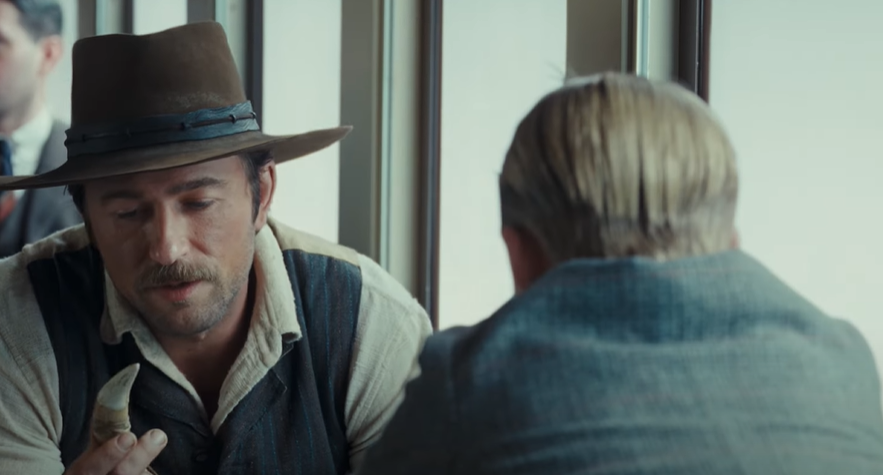
This declaration is a powerful thematic anchor for “1923.” It underscores the series’ commitment to deconstructing the romanticized myths of the Old West, revealing the harsh realities, the moral ambiguities, and the often-ignored perspectives of its diverse inhabitants. Spencer, a man who has lived through the brutal truth of war and colonial expansion, is uniquely positioned to impart this cynical yet vital lesson. His words resonate with the broader narrative of the Duttons, a family whose wealth and power are inextricably linked to a land acquired through bloodshed and complex compromises, often at the expense of others.
The heart of the scene, however, culminates in a remarkably tender and telling exchange. Tucker’s gaze falls upon a singular object hanging around Spencer’s neck: “What’s that?” Spencer reveals it to be a lion’s tooth, a tangible relic of his past in Africa, a world away from the burgeoning civilization of Montana. “There’s no lions here,” Tucker observes, stating the obvious with child-like directness. Spencer’s simple response, “That’s ’cause it’s not from here, it’s from Africa,” sets the stage for the pivotal “trade.”
Tucker, ever the astute negotiator, proposes, “Wanna trade?” offering a “nice knife” in return, a knife he claims is “from the Revolution War.” The irony is palpable; a historical object whose authenticity is questionable, received in a dubious trade, against a deeply personal, undeniably genuine artifact of Spencer’s lived experience. The conversation around the knife reinforces the earlier theme of truth versus fabricated history. “Our teacher said we won that one,” Tucker notes, to which Spencer replies with a knowing, almost melancholic smile, “You and I are living proof of that.” This line, delivered with characteristic Spencer brevity, hints at the intergenerational legacy of conflict and survival that defines his lineage.
Spencer’s hesitation about the trade reveals a vulnerability rarely seen in his character. The lion’s tooth is not just a memento; it’s a placeholder for an unspoken future. “See, I don’t know I was I was planning on giving this to my son one day,” he admits, exposing a deep-seated longing for family, a stark contrast to his solitary existence thus far. Tucker’s innocent, yet profound, retort – “Don’t think you meet him. Think you gotta make him.” – cuts through Spencer’s hardened facade, reminding him that the future is not simply something to be endured, but something to be actively built. It’s a moment of unexpected wisdom from a child, perhaps unconsciously echoing the Dutton imperative to forge a future, to make their legacy.
Despite the obvious imbalance in perceived value – a mass-produced pocket knife against a unique artifact from a distant continent, imbued with personal meaning – Spencer agrees to the trade. “You got a deal. That’s a good trade,” he concedes, a hint of amusement in his voice. Tucker, the shrewd young entrepreneur, immediately gloats, “You got suckered. Know how many pocket knives are out in the world? I bet this is only lion’s teeth in the whole country.” Spencer’s quiet acceptance – “Yeah, you may be right” – speaks volumes. He understands that the true value of the exchange lies not in monetary worth, but in the intangible.
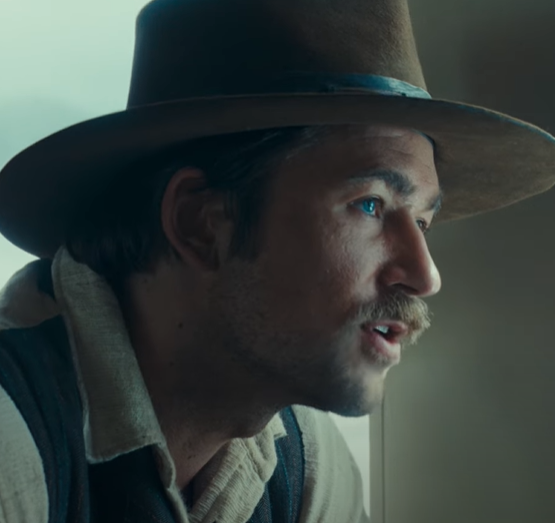
For Spencer, this trade is a momentary surrender of his guarded self, a rare act of connection. The lion’s tooth, a symbol of his past traumas and solitary existence, is exchanged for an object that, however trivial, represents a shared human interaction, a fleeting moment of innocence and hope. It is a subtle shift, a crack in the armor of the man who has spent years running from the ghosts of his past. The scene suggests that Spencer’s return to Montana is not just a physical journey, but an emotional one, a slow, painful reintegration into the human fold. The lion’s tooth might have been intended for a future son, but in its exchange, Spencer symbolically begins to make room for that future, allowing a small, unexpected piece of it to enter his present.
“Spencer’s Trade” is a masterclass in concise storytelling. In a mere few minutes, “1923” manages to weave together complex themes of historical revisionism, the weight of legacy, the longing for connection, and the unexpected wisdom found in the simplest of interactions. It reinforces Spencer Dutton’s profound arc, showing that even the most hardened of individuals can find glimmers of hope and humanity in the unlikeliest of places. As the train continues its journey, grinding relentlessly towards the Dutton family’s waiting struggles, this small exchange between a battle-worn man and a precocious boy leaves an indelible mark, reminding viewers that even in the vast, unforgiving landscape of the American West, moments of profound grace can redefine a life. The true treasures, “1923” continually reminds us, are rarely found in what we possess, but in the truths we confront and the connections we forge.