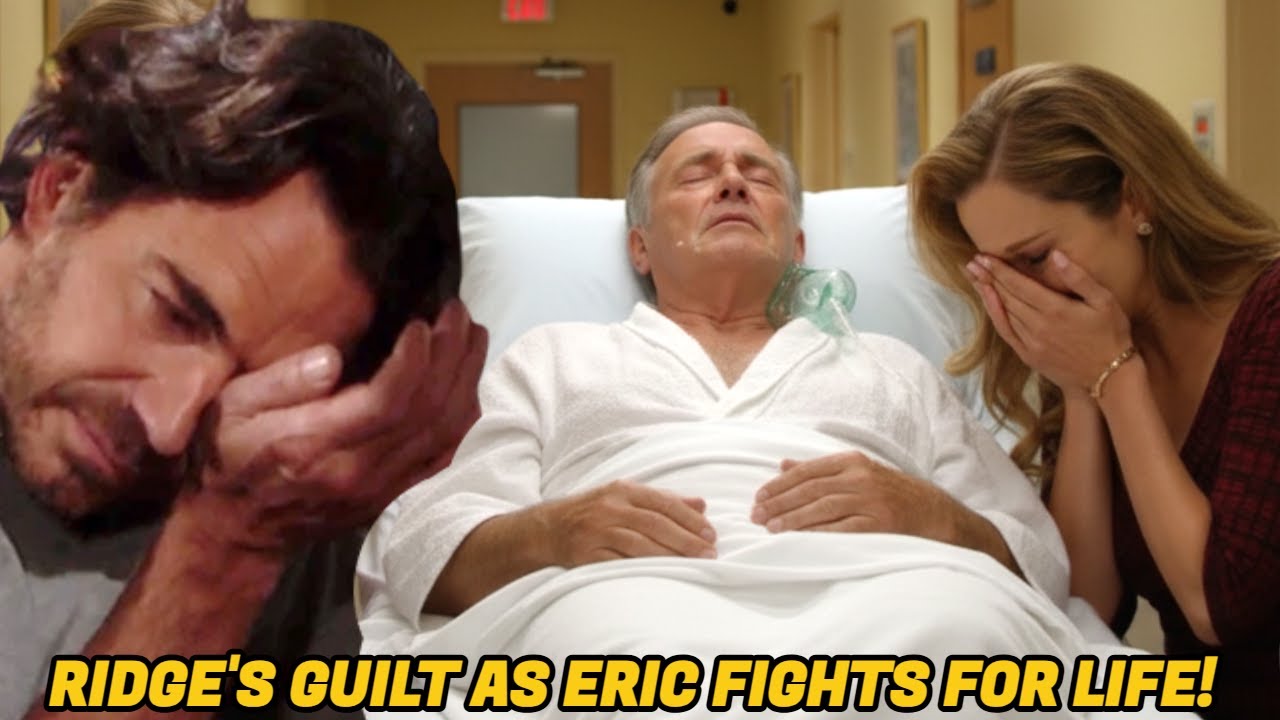
The tension between Eric Forrester and Ridge had been building for months, following an all-too-familiar cycle: polite restraint, rising irritation, and finally sharp, painful exchanges neither truly intended to leave unspoken. But this time, something felt irrevocably different. Their dispute over Eric stepping down was no longer a simple business conversation — it had become a confrontation about identity, legacy, and the frightening reality of aging.
For Eric, fashion was never merely a career. It was his language, his purpose, the foundation on which he built both his family and his sense of value. So hearing his own son urge him to retire felt less like concern and more like being erased while still alive.
Ridge, meanwhile, clung to the idea that he was acting out of duty. He told himself he was safeguarding the future of Forrester Creations, ensuring its survival in a rapidly evolving industry. But beneath the surface lay unresolved resentment — years spent chasing Eric’s approval, years of feeling overshadowed by the man he was expected to replace. Ridge insisted he was being practical, yet the bite in his voice betrayed how personal the issue truly was.
Their final argument before Eric collapsed was vicious. Gone were the diplomatic tones — replaced by raw accusations and unfiltered emotions. Eric accused Ridge of being eager to push him aside, confusing progress with abandonment. Ridge fired back with warnings about declining performance and fears whispered among board members.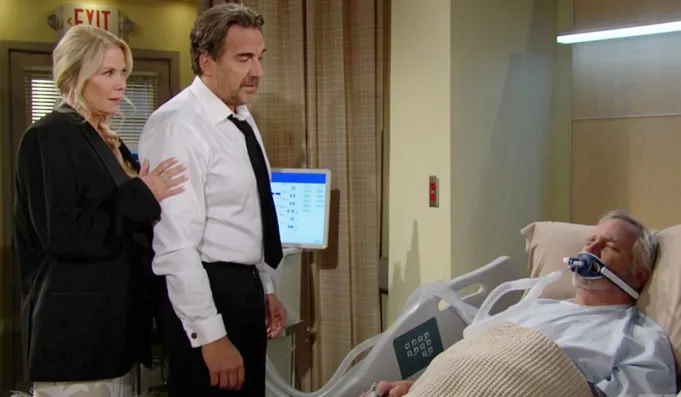
The conversation spiraled until Eric suddenly grabbed his chest. For a moment, Ridge assumed it was another dramatic attempt to shift the conversation. But reality hit fast. Eric’s face went pale, his body weakened, and the commanding presence he once held evaporated in front of Ridge’s eyes.
Panic quickly replaced anger. Medical staff rushed in, but the emotional shock reverberated through the Forrester family. No one knew whether Eric had suffered a heart attack or a stroke — only that the situation was dire.
The news spread rapidly, pulling family members from their daily lives and placing them in the cold, sterile halls of the hospital. Fear, regret, and unresolved conflicts followed each of them inside.
For Ridge, the waiting room became a prison of guilt. He replayed the argument endlessly, dissecting every word he had thrown at Eric. Intellectually, he knew he didn’t cause the medical emergency. Emotionally, he could not escape the guilt. The timing was too cruel. His words felt like the final straw on an already strained body.
As hours passed with little information, Ridge unraveled. He was no longer the confident leader who commanded boardrooms — he was a son who feared his last conversation with his father had been fueled by anger instead of love.
The rest of the family felt their own reckoning. Brooke saw Ridge’s torment, recognizing the signs of someone punishing himself from the inside out. Steffy, shaken by the possibility of losing her grandfather, began questioning whether the family’s obsession with ambition had blinded them to compassion. Even Thomas grew contemplative, realizing how much he had sought Eric’s approval and how insignificant those desires suddenly felt.
When the doctor finally delivered an update — that Eric was alive but in critical condition — the family exhaled collectively. Relief washed over them, but it was fragile, overshadowed by uncertainty.
Ridge’s transformation began in those quiet, anxious hours. He realized the conflict with Eric had never been solely about retiring. It was about Ridge’s own need for validation, his desire to prove himself worthy without diminishing his father’s legacy. For the first time, he understood the depth of Eric’s fear: not of change, but of becoming irrelevant.
That night, Ridge remained at the hospital long after visiting hours ended. Memories surfaced — watching Eric sketch late into the night, the pride in Eric’s eyes when Ridge first succeeded as a designer. Ridge whispered an apology through the quiet, unsure if Eric could hear him but needing to speak the truth anyway.
Eric eventually regained consciousness, though weak and disoriented. The relief in the room was immediate but tempered by the recognition that recovery would be slow and uncertain. When Eric looked at Ridge, the flicker of disappointment mixed with understanding cut Ridge deeply.
As days passed, Eric began to voice fears he had never expressed before — fears of being discarded, of losing purpose, of watching his life’s work move on without him. Hearing these vulnerabilities forced Ridge to reconsider what leadership truly meant.
The entire Forrester family emerged from the ordeal changed. Old grievances didn’t disappear, but they mattered far less. Eric’s collapse drew a line between the family’s past and its future. Power and legacy no longer overshadowed what truly remained: connection, forgiveness, and the realization that time — no matter how long it seems — is never guaranteed.
And in that realization, the Forresters finally began to redefine what family meant beyond ambition and pride.