In the brutal, beautiful, and often unforgiving world of Taylor Sheridan’s “Yellowstone,” characters are rarely simple. They are forged in fire, scarred by their pasts, and eternally bound to the land that defines them. Few embody this tumultuous journey with as much raw authenticity and a hauntingly melodic voice as Walker. Introduced as a taciturn, enigmatic ex-con, Walker’s trajectory from defiant drifter to reluctant branded man, and later, the bunkhouse’s resident troubadour, paints a compelling portrait of fate, loyalty, and the grim price of freedom on the Yellowstone Dutton Ranch.
His initial appearance sets the stage for a character perpetually at odds with the world, and indeed, with himself. Rip Wheeler, the Dutton family’s enforcer and ranch foreman, discovers Walker – a man fresh out of prison, with a rap sheet that includes “manslaughter.” The very first exchange crackles with tension: “What’s your name?” Rip demands. “Walker,” comes the laconic reply. “That is my first name.” His insolence is immediate, his past veiled in a shroud of weary defiance. Walker is a cowboy, claiming lineage from legendary Texas ranches like the 6666 and the Pitchfork, a testament to his skill and his deep-seated connection to the land. But it’s a skill he’s squandered, his past a chain around his ankle. His crime, a bar fight gone fatally wrong, reveals a man capable of sudden, devastating violence, yet seemingly bewildered by its consequences. “Fucker just went down and died. Can’t explain it.” This detached recounting hints at a man who has witnessed and inflicted too much, a soul already burdened by the dark side of human nature.
Rip, ever the pragmatic predator, sees potential in the broken. He offers Walker a job, but with a caveat: “Cons gotta pay a price to work the Yellowstone.” Walker, desperate and out of options, accepts. This is his first step into the gilded cage of the Dutton Ranch, a place where employment is less a contract and more a life sentence. The “price” Rip speaks of is, of course, the Yellowstone brand – a searing mark of ownership and unwavering allegiance that fundamentally alters the wearer’s existence. Walker takes it, initially believing it to be a mark of trust, a symbol of belonging. The harsh reality, however, is quick to set in.
“You should have thought of that before you took the brand,” Rip chillingly informs him when Walker, newly marked, attempts to assert his boundaries. “Trust is you do what we ask, Walker.” The truth dawns with brutal clarity: the brand is not a promise of trust, but a seal of absolute control. Walker’s initial swagger gives way to a profound sense of entrapment. “There’s something evil about this place. You feel that? It’s like this land don’t want us here,” he confides to Jimmy, a fellow reluctant ranch hand. He desperately wants to quit, but the ranch’s grip is tightening. “I hate to tell you this, but you ain’t going nowhere,” Beth Dutton, the ranch’s ruthless matriarch-in-waiting, later confirms, revealing her own, unseen brand. The Yellowstone isn’t just a ranch; it’s a living, breathing entity, a vortex that consumes those who cross its threshold.
Walker’s attempts to resist are met with Rip’s unwavering, brutal authority. When he balks at “low man work” or sings his plaintive tunes instead of toiling, Rip asserts his dominance. A heated confrontation in the field escalates to a chilling knife point, Rip’s blade pressed against Walker’s throat. “If you wanna die today, Walker, you’ve already taken your last step.” The message is clear: defiance means death. Walker, ever the survivor, retreats, but the seed of rebellion remains.
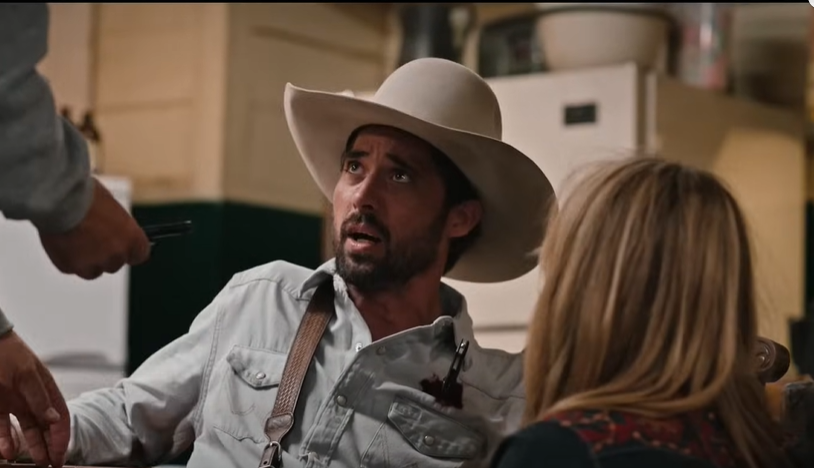
The true turning point, the macabre initiation that irrevocably binds Walker to the ranch’s dark underbelly, comes when Rip forces him to become an accessory to the murder of Jamie Dutton’s biological father, Garrett Randall. Walker is manipulated into driving the rental car, wiping it clean, and then disposing of evidence. “You just made me an accessory to murder, didn’t you, Rip?” Walker accuses, his voice laced with venom. “What do you mean accessory? My prints aren’t in that rental car… You did.” It’s a masterclass in manipulation, a cruel baptism by fire that eliminates any vestige of Walker’s external freedom. He now shares the ranch’s deepest, darkest secret, his fate intertwined with theirs, his ability to speak out curtailed by self-preservation.
Yet, “Yellowstone” is a show built on complex loyalties and shifting alliances. Kayce Dutton, torn between his family’s brutal methods and his own moral compass, offers Walker a sliver of hope. After the murder, Kayce lets Walker go, extracting a promise: “Everything you saw and heard on this ranch stays with you.” Walker, longing for true freedom, pledges his word and leaves the state. For a brief period, he is genuinely free, a ghost of his former self, disappearing into the vast anonymity of America.
But the Yellowstone, as Walker himself notes, is a “magnet for everything that’s wrong in this fuckin’ world.” His parole requirements, demanding he check in periodically, force him back into Montana, and inevitably, back into the orbit of the ranch. He’s found singing at a bar, a stark reminder of his broken promise to Kayce. His return is met with immediate suspicion and hostility, especially from Rip, who views him as a walking liability. “You said you were gonna leave the state and never come back,” Kayce confronts him. Walker’s explanation – his parole – is logical, yet it holds little sway in the world of the Duttons, where the only rules are theirs.
This second encounter with the ranch forces Walker into an even deeper commitment. He didn’t want his job back, yet Rip, seeing him as a threat, demands he “prove himself.” The choice is stark: “Beats dyin’. As far as I see it, that’s the only other option right now.” Walker, once again, chooses life, accepting his fate as a branded man, albeit an unwilling one. This return marks a subtle shift; no longer openly rebellious, he’s resigned, accepting his place in the hierarchy, though still holding onto a sliver of his independent spirit.
His unique role on the ranch becomes even more defined by his music. Walker is the bunkhouse bard, his mournful country songs often narrating the very despair and longing that permeate his own existence. His guitar becomes both a solace and a point of contention. His quiet defiance manifests through his art, a stark contrast to the raw, physical violence that often defines the ranch hands’ interactions. This contrast violently explodes when Lloyd Pierce, an old hand, destroys Walker’s guitar in a fit of jealous rage over Laramie. The ensuing brawl is brutal, a visceral reminder of the untamed nature of the bunkhouse, and of Walker’s perpetual outsider status. The incident is a crucible, testing the tenuous peace between the men. Rip, in an unexpected gesture, orders Lloyd to replace the guitar, subtly acknowledging Walker’s value beyond just a ranch hand, perhaps as a necessary element in the bunkhouse’s delicate ecosystem.
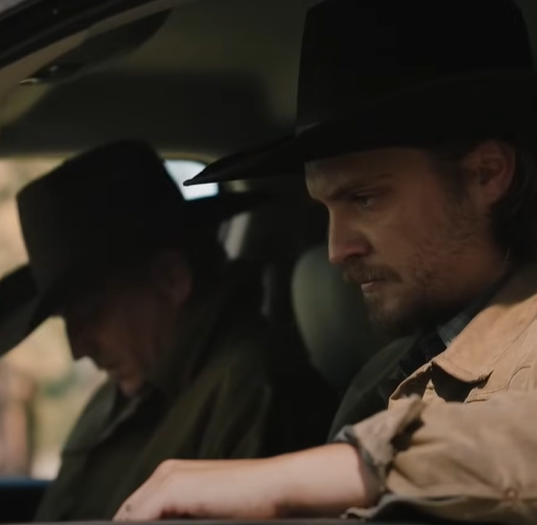
Walker’s evolution isn’t one of becoming a loyal Dutton devotee, but rather of a man who, having seen the worst of humanity (“We’re the meanest fuckin’ thing on this planet”), understands his limited choices. He’s the reluctant insider, the cowboy who’d rather be “long gone” but is tethered by the brand, by secrets, and by the sheer lack of alternatives. His songs, filled with wanderlust and heartbreak, become a poignant counterpoint to the ranch’s violence, a reminder of the freedom he constantly craves but can never quite attain. He is Yellowstone’s resident poet of despair, a living embodiment of the ranch’s beautiful, brutal, and inescapable grip.
(Fade out with the gentle strumming of a guitar, playing a melancholic country tune, hinting at the vast, desolate landscape of Montana and the equally vast and desolate inner landscape of a branded man.)