In the sprawling, breathtaking, yet unforgiving landscape of Montana, where the Yellowstone Dutton Ranch stands as a monumental testament to American legacy, a singular truth echoes louder than any gunshot: this land is not merely property; it is a promise, a birthright, and a battleground. For five seasons, Taylor Sheridan’s acclaimed neo-western Yellowstone has captivated audiences with its raw portrayal of a family fiercely clinging to its ancestral home, frequently pitting the Duttons against an endless parade of those who dare cross their hallowed borders. From naive tourists to cunning corporate moguls and unruly thrill-seekers, the Yellowstone Dutton Ranch is a magnet for conflict, and the family’s response is consistently, thrillingly, and brutally uncompromising.
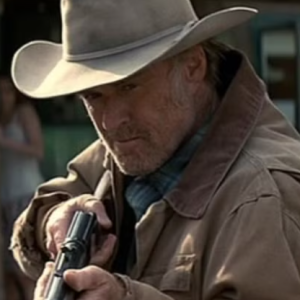
The very premise of Yellowstone is rooted in the constant siege of the ranch. At its heart lies the Dutton family patriarch, John Dutton (Kevin Costner), a man carved from the same granite as the mountains he defends. His philosophy is simple, ancient, and absolute: “We don’t share land here.” This ethos is established early and often, setting the tone for every encounter. Take, for instance, the seemingly innocuous intrusion of tourists eager for a close-up with wildlife. What begins with a casual, “it seems friendly,” about a wild animal quickly devolves into John’s steely command: “Get back! All right, get back before that thing eats somebody… Well, it’s not. Now get back.” The trespassers, in their metropolitan innocence, offer a polite, “We just wanted to even see that fence.” John’s response cuts through their urban politeness like a barbed-wire fence: “That’s mine. That fing fence down there, that’s mine too. Everything this side of that mountain, all the way over to here, mine too. You’re trespassing.”
This initial interaction isn’t just about property lines; it’s about a clash of ideologies. The trespassers’ bewildered, almost philosophical musing – “He says that it’s wrong for one man to own all this. He says you should share with all the people. Yeah, this is America” – is met with John’s curt, definitive dismissal: “We don’t share land here.” It’s a foundational statement that defines the Duttons’ worldview, a stark contrast to the modern, communal ideals of city dwellers. For John, land ownership isn’t a social construct to be debated; it’s an inherited truth, a sovereign right protected by blood and generations of toil. This scene is a masterclass in establishing the Duttons’ non-negotiable stance without resorting to immediate violence, instead using the crushing weight of their conviction.
The threat escalates from curious sightseers to calculated corporate predation, embodied by the smooth, disingenuous Ellis Steele (John Emmet Tracy) representing “Providence Hospitality Management.” Their pretense of being “lost” is paper-thin, their true agenda immediately apparent to the Duttons. Standing on what they believe is their newly acquired land, Steele oozes false cordiality: “You all staying at the Sporting Club? They own it. Who are they? Providence Hospitality Management. I’m Ellis Steele. My firm is representing Market Equities.” The Duttons, ever direct, demand, “We don’t know what that is.” Steele’s glib explanation – “They manage resort properties. We watch out for their interests. This your land? Incredible”—is laced with a condescension that disguises a predatory intent.
The exchange between Steele and John Dutton is a simmering pot of unspoken threats. When Steele attempts to make pleasantries and establish a rapport – “I didn’t catch your name,” – John’s icy retort, “That’s ’cause I didn’t offer it,” sets the stage for the unbridgeable chasm between them. Steele’s parting shot, “Why don’t you come by the resort and have dinner on us? After all, you’re going to be neighbors. It’s best if you all get along,” is less an invitation and more a declaration of war. The Duttons recognize the thinly veiled menace in the proposition of being “neighbors,” understanding that these newcomers seek not coexistence, but acquisition. The scene perfectly articulates the insidious nature of corporate expansion – smiling faces masking relentless ambition.
Yet, even with high-stakes corporate maneuvering, some of the most memorable trespasser encounters come from the sheer audacity of individuals. Enter Beth Dutton (Kelly Reilly), John’s venomous daughter and the family’s intellectual assassin. Her confrontation with a fly-fisherman nonchalantly wading in their private river is a masterclass in psychological warfare. “How you doing?” she greets, feigning politeness, before unleashing her signature venom: “You’re trespassing.” The angler’s flippant, “I can’t. That’d be trespassing,” after being told to get out, only fuels Beth’s fury.
Beth’s dialogue is a theatrical performance designed to disorient and dominate. Her quick wit, her cutting insults – “The women in this valley have gotten a lot more fashionable,” followed by the savage “Chippendales changed their policy on capped teeth,” – leave the angler stumbling, completely outmatched. He attempts to assert his own claim: “My family owns the place upriver, Cross Creek Ranch. You know it?” Beth, however, swiftly demolishes his pretense of casual sport, exposing his entitlement. Her dismissive, “I dine on my joyful life,” when he inquires if she has an “interest in dinner,” is a perfect encapsulation of her self-assured, uncompromising nature. The scene culminates with her chilling, simple command: “Just stay off our fing land, okay?” and his sheepish, “Yes ma’am. I’ll stay off your fing land, I promise.” Beth’s confrontations are often a blend of brutal honesty and theatricality, exposing the trespasser’s weakness and asserting the Duttons’ absolute domain.
However, when diplomacy, even Beth’s unique brand of it, fails, the Yellowstone Dutton Ranch relies on its formidable enforcer: Rip Wheeler (Cole Hauser). Rip is not just a ranch hand; he is the ranch’s shadow, its brutal efficiency personified. His encounters with trespassers are often less about dialogue and more about swift, decisive action. The scene involving a group of loud, disrespectful bikers camping on Dutton land exemplifies this. “You can’t be here. It’s private property,” Rip states, his voice a low growl. The bikers, convinced they are on “National Park” land, challenge him, “Science says Yellowstone got a big fing Y on it. The Y is for the Yellowstone range.” Rip’s terse correction, “That’s national park. This is the Dutton Ranch. It’s the Yellowstone D-R Ranch. Listen, I need you to move,” is met with insolence.
The situation escalates rapidly when a biker questions Rip’s authority: “That badge says livestock agent. That’s right, it’s fing cow police. Look at this pink-haired hick mad-dogging me.” The slurs are a fatal error. Rip, whose fuse is notoriously short when the ranch is disrespected, snaps. “You got a problem, bh?” he snarls, before the first punch is thrown. The ensuing brawl is a visceral display of Rip’s power. He takes a beating, breaks his hand, but never yields. The violence is raw, unflinching, and serves as a stark reminder that on the Yellowstone, consequences for disrespect are physical and immediate.
The most iconic and disturbing demonstration of Dutton justice comes when the bikers return, or rather, when Rip and the ranch hands find them. Having damaged a fence, they are confronted by Rip, who delivers a chilling sermon on the meaning of home and consequence. “This field’s mine. That fence, you damaged both. Then you came back to damage it more. This is my home. If I did this to your home, what would you do?” One biker defiantly states, “Well, I’d kill you.” Rip’s chilling affirmation, “That’s right,” seals their fate.
The bikers, now completely at Rip’s mercy, are ordered to dig their own “graves” – holes meant to serve as both punishment and a lasting warning. “The man said if you didn’t leave, we’d bury you here. And you didn’t leave. We keep our word in this valley.” The scene is masterfully unsettling, a psychological torment as much as a physical one. The bikers, reduced to pathetic figures, plead for release, promising to leave. But it’s too late. Rip wants them to dig, to feel the weight of their transgression. “I don’t want you to leave. I want you to dig.”
The terror in the bikers’ eyes, their desperate apologies, and Rip’s unyielding gaze underscore the brutal finality of Dutton justice. When one pleads, “I have children,” Rip’s cold reply – “So do I. From what I’ve seen, yours will be better off without you” – reveals the depths of his commitment and the grim sacrifices made for the ranch. The scene ends not with their death, but with a living death sentence: “I’m gonna leave these holes, just like this, right here in the middle of my field. And if you ever come back again, I’m gonna fill them. You understand?” The terrified bikers parrot his words, pledging never to return to Montana, a promise Rip ensures they will keep.
These encounters, from the casual tourist to the corporate threat and the violent biker, collectively define the Duttons’ unwavering resolve. They are not merely reacting to trespass; they are enforcing a code, a way of life that demands respect for the land and its caretakers. The lingering presence of those dug holes serves as a constant, stark monument to their uncompromising defense. As John Dutton contemplates the next major threat – an airport development – the series constantly reminds us that the battle for the Yellowstone is never-ending. The Duttons’ war on trespassers is more than just thrilling television; it is a primal struggle for survival, identity, and the very soul of the American West, proving that for this family, the land is worth fighting – and dying – for. And for audiences, it’s a dramatic, engaging, and often shocking display of what happens when tradition collides with a world determined to carve it up.