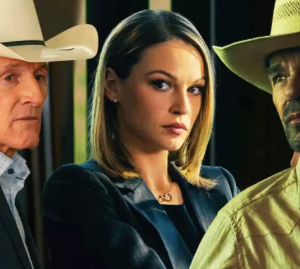
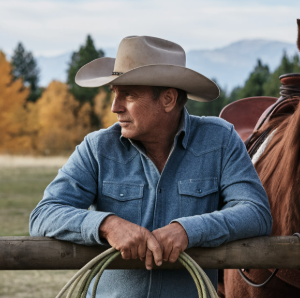
The world of Yellowstone, long a stage for brutal power struggles and unwavering loyalty, has been irrevocably altered. In a seismic shift that leaves no character, or indeed, no viewer, untouched, the series delivered a gut-wrenching one-two punch: the shocking, highly ironic assassination of corporate antagonist Sarah Atwood, followed swiftly by the unthinkable — the clinical, cold-blooded murder of patriarch and Governor John Dutton himself. As the “Stories from the Bunkhouse” panel aptly dissected, these events don’t just shuffle the deck; they throw the entire board into disarray, leaving a trail of vengeance, fear, and profound isolation in their wake.
Sarah Atwood, the cunning and ruthless Market Equities attorney who had orchestrated countless schemes against the Duttons – including a direct attempt on John Dutton’s life – met a demise as brutal as it was darkly poetic. Her final moments, described with chilling clarity by the “Bunkhouse” hosts, saw her fall victim to the very shadowy figures she had contracted to eliminate her adversaries. “I thought of Sarah as the big bad, as the sort of monster at the end of the story,” one host mused, encapsulating the pervasive belief that she was the ultimate puppet master. Yet, in a twist of fate worthy of Shakespearean tragedy, the strings she pulled ultimately became the noose around her own neck. The image of the “Bumpered Hill” inquiry, the deceptive GPS, and the terse “Are you Sarah Atwood?” before the fatal shots, painted a picture of meticulously planned, professional execution.
The panel’s insights into Sarah’s miscalculation were particularly acute. “She overplayed the hand,” one host concluded, suggesting an almost hubristic belief in her untouchability. Her willingness to pay exorbitant sums – anywhere from “20 to 100 grand” for a hit, according to the Bunkhouse estimates, though a hit on John Dutton would surely command a far higher price, perhaps “40, $50 million” – blinded her to the very real possibility of becoming a target herself. This chilling vulnerability, the idea that “anyone can get taken out at any moment and no one’s safe,” serves as a stark warning, resonating through the entire narrative and foreshadowing the even greater tragedy to come.
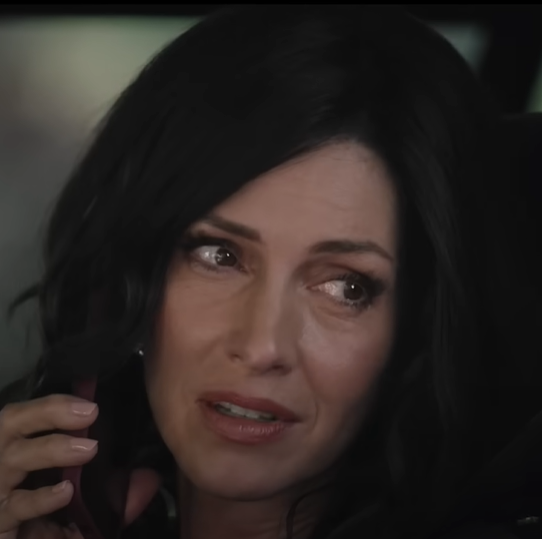
For Jamie Dutton, long a pariah within his own family, Sarah’s brutal end represented more than just a shocking death – it was the severing of his last tangible tether, his final perceived ally. The terror in his voice as he heard the gunshots over the phone, the sudden silence, spoke volumes. “That was Jamie’s last point of contact. Jamie’s last ally. He gave everything up,” the Bunkhouse panel observed, highlighting the profound isolation now engulfing him. He had banked his entire future on this alliance, sacrificing family loyalty and personal integrity for a fleeting sense of power and acceptance from Market Equities. Now, not only is that corporate lifeline compromised, but the very entity he sought to serve has demonstrated its capacity for ruthless, indiscriminate elimination, leaving Jamie to ponder, “Am I next?” The unknown, faceless nature of these assassins only heightens the gnawing dread.
Yet, even Sarah’s shocking exit paled in comparison to the episode’s true gut punch: the sudden, clinical assassination of patriarch John Dutton himself. The scene, devoid of the epic shootouts or valiant last stands one might expect for a character of his stature, was rendered with an unemotional, sterile proficiency that was profoundly unsettling. “Dude was just sleeping and then that’s it. It just happened so quick,” the Bunkhouse hosts lamented, articulating the collective shock. Having witnessed generations of the Dutton family fight tooth and nail for survival in 1883 and 1923, to see John, a man of such “feeling and love and care and commitment and honor,” dispatched with a cold, methodical precision, was truly “painful.” A titan of the land, a symbol of unwavering resolve and deep-seated emotion, reduced to a mere statistic with a flick of a switch.
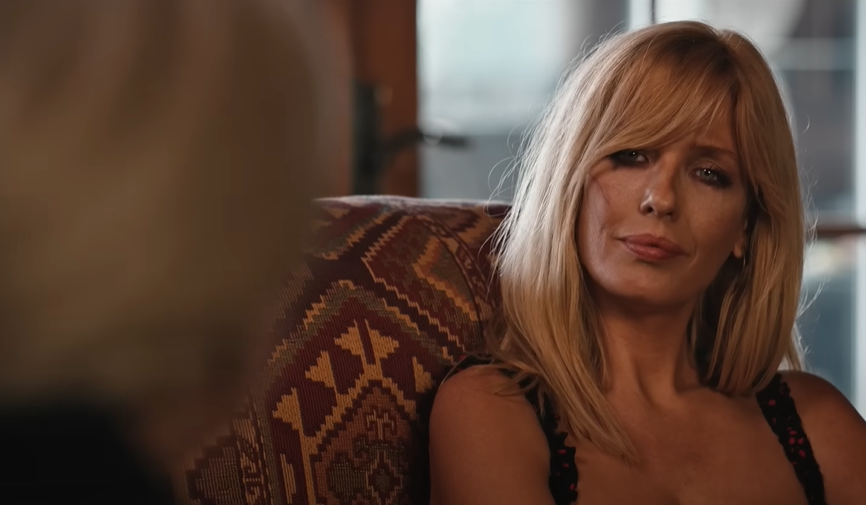
This sterile efficiency, however, is merely the calm before the storm. The Bunkhouse panel meticulously dissected the aftermath, noting Kayce’s immediate, almost robotic shift into soldier mode. Bruising along the neckline, the medical examiner’s suggestion of “undetermined” cause of death instead of suicide – these seemingly small details ignite the inferno of Dutton vengeance. “If it was a suicide, there’s nothing to do but grieve. Now, if it was a murder, there’s a mystery to solve. There’s revenge to be taken,” the hosts explained, pinpointing the critical pivot.
This discovery galvanizes the remaining Duttons. Kayce, the former Navy SEAL, puts on his “filter” to diagnose the crime scene with the same methodical approach as the killers, preparing to unleash the full force of his grief and fury. Beth, the fiery, uncompromising daughter, and Rip, the loyal, primal enforcer, become “bloodhounds,” their singular focus now honed on tracking down their father’s murderers. The switch, as the Bunkhouse crew put it, “accelerates every character’s motive,” propelling them at “full speed towards their goal.” This isn’t just a quest for justice; it’s a primal, unyielding demand for retribution, a defining moment that will undoubtedly shape the remainder of the series.
Amidst this maelstrom of death and impending vengeance, Jamie Dutton continued his desperate, pathetic dance for political survival. His constant “pivot and wriggle” to secure his position as Market Equities’ “best pawn” became increasingly frantic, especially as he grappled with the implications of Sarah’s death. He fought against eminent domain one moment, then offered to sell out the state the next, a clear indication of his self-preservation mode. However, his manipulative chess game was abruptly disrupted by the new interim governor, who swiftly, and devastatingly, “took Jamie off of his perch.” The order for the Attorney General to recuse himself from any investigation into John Dutton’s death, “for obvious reasons,” effectively neutered Jamie’s power.
“He has no use. No value,” the Bunkhouse hosts concurred, articulating Jamie’s devastating new reality. Stripped of his authority, abandoned by his corporate patrons, and devoid of any familial support system – “the person that you were going to be with no longer exists,” a cruel nod to Sarah’s demise – Jamie is left in a state of utter, terrifying isolation. His golden opportunity has curdled, leaving him as a man with “no value to anybody,” adrift in a world he tried so desperately to control.
The Bunkhouse commentary further illuminated the Duttons’ long and bloody history, as they engaged in a game of “Guess the Threat,” revisiting past villains who sought to dismantle the family’s legacy. From the ruthless Wade and his son Clint, to the calculating Caroline, the anonymous biker brawl antagonist, the manipulative Malcolm Beck, and the arrogant Roarke – each enemy, in their own way, underestimated the Duttons’ resilience. But unlike these tangible, often bombastic foes of the past, the current threat is faceless, an unknown entity that cannot be fought directly. This shift from identifiable adversaries to an invisible, methodical force underscores the heightened stakes and the terrifying uncertainty that now engulfs the Yellowstone ranch.
The recent seismic shifts in the Yellowstone narrative underscore a terrifying truth: in the relentless struggle for power and land, no one, not even the seemingly invincible Duttons, is truly safe. With John gone, and Jamie a broken, isolated figure, the future of the ranch and its legacy falls squarely on the shoulders of Kayce, Beth, and Rip. Their primal instinct for vengeance has been ignited, promising a brutal, unflinching retribution against the unseen forces that dared to strike at the heart of their empire. The game has changed, and as the dust settles on these two shocking deaths, one thing is clear: the fight for Yellowstone has never been more perilous, or more personal.